AI Song Generator with My Voice: Choose the Right Input Before You Upload

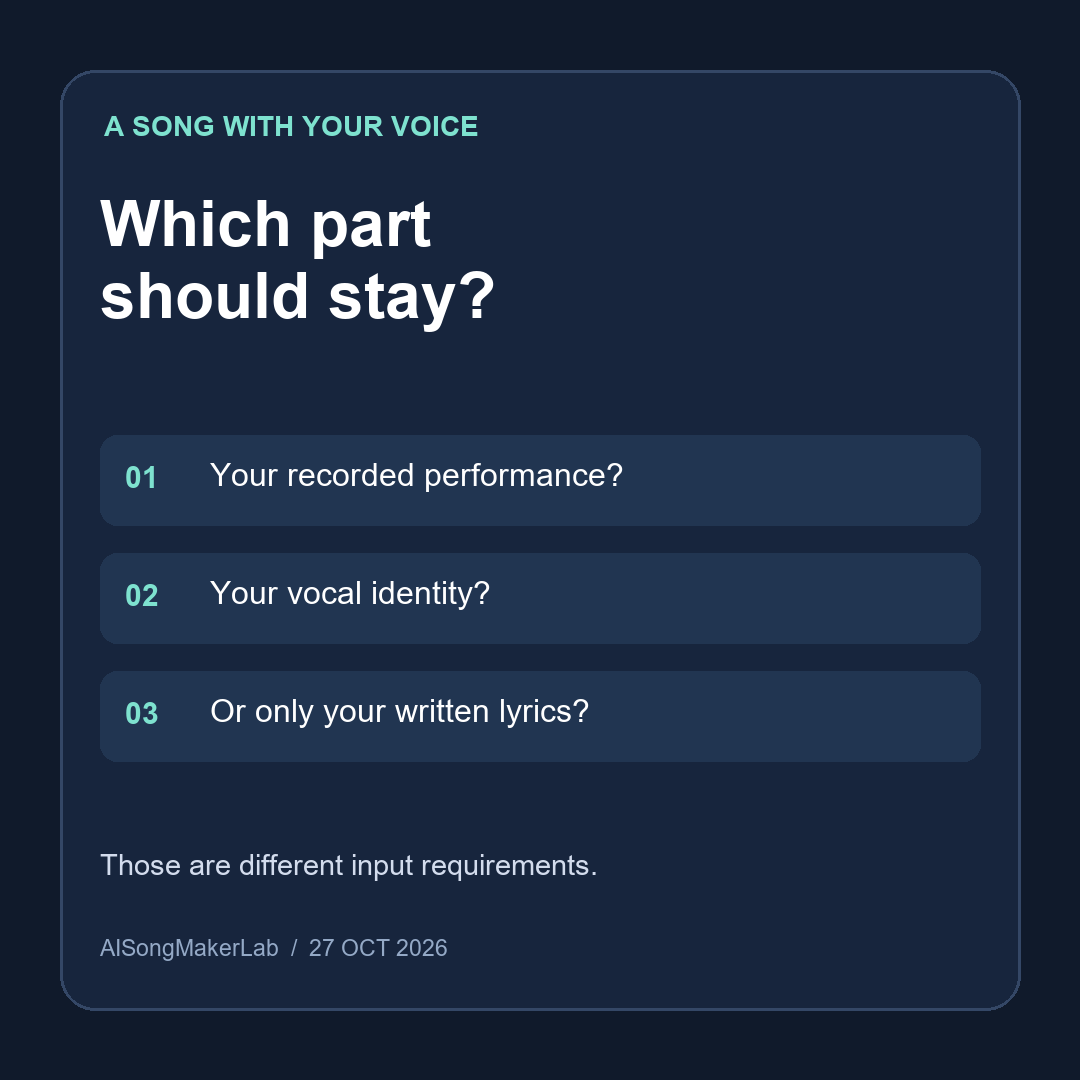
To make an AI song with your voice, first decide what you want to keep: your recorded performance, your vocal identity, or only your lyrics. An own-lyrics field does not establish that the singer will sound like you. Choose a workflow that explicitly accepts the input you have, then use a short, self-recorded passage to check the result before committing to a full song.
Published 27 October 2026. Five original fictional exercises; no voice clone, vendor output or product benchmark is claimed. This guide does not require uploading another person's voice.
What do you mean by “my voice”?
If you already sang a melody and want instruments around it, your central question is whether the workflow preserves that recording or replaces it. If you want a new performance that resembles your voice, look for explicit voice-personalization support and examine its requirements. If you wrote lyrics but have no recording, a lyrics-to-song workflow can create a sung draft, but your words alone do not provide your vocal identity.
Treat “audio upload,” “custom lyrics” and “my voice” as separate claims. An audio upload might guide a melody or arrangement without retaining your singer. A preview can demonstrate a voice without establishing that the downloaded song uses the same version. Before paying or recording a long session, identify the supported input, the intended transformation and the output you can actually evaluate.
Keep the original recording outside the service as your reference. Use your own voice for these exercises, with no names or background conversations you do not intend to share. Read the current recording and retention instructions before submission. If the service asks for a verification phrase, record it yourself as instructed; these fictional lyric exercises are not substitutes for account or voice verification.
Five original exercises with a different decision in each
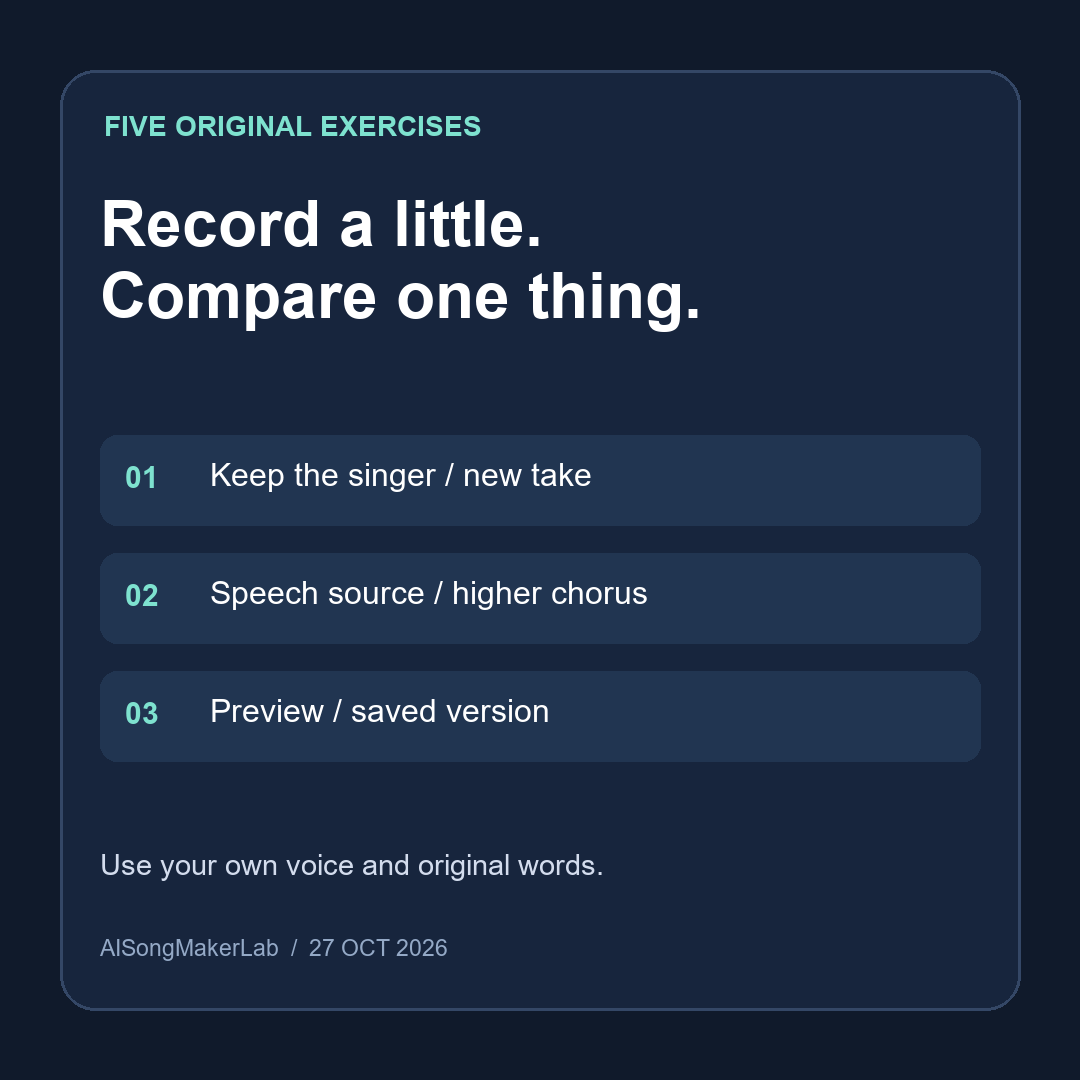
These cases supply new words, a task brief and a listening question. They do not supply a fabricated voice sample or pretend a generator passed. Record only the case that matches your intended task. Use the same saved source when comparing attempts so the question stays clear.
1. Keep the singer, add the band
Original lyric:
A paper moon above the door
We leave our worries on the floor
Your old piano starts to glow
I sing the only tune I know
Input: Your own sung recording of these lines, with a melody you create. Save an untouched copy. Brief: Add a gentle acoustic arrangement around this performance; preserving the recorded singer and phrasing is the priority. Listen for: Does the result retain the specific starts, pauses and held words you sang, or does it sound like a different performance? Next decision: If the voice is replaced, decide whether a replacement is acceptable. If preservation is essential, do not treat a pleasant replacement as a successful accompaniment workflow. Boundary: Similar timing by ear is not proof that the original audio was preserved bit for bit.
2. Same words, a new performance
Original lyric:
We set the little lantern free
And watched its light above the sea
Tomorrow has a different name
But I will meet you all the same
Input: A short reference of your own voice, if the selected service explicitly supports it, plus this lyric. Brief: Create a new gentle pop performance using the supported personal-voice workflow. Listen for: Compare vowel color, consonants and the change between quieter and stronger phrases against your reference. Next decision: Mark the voice as recognizable, uncertain or unlike your reference in your own listening record. Keep musical preference separate: a catchy take can still fail your voice requirement. Boundary: A listener's impression is not an identity verification or a numerical similarity score.
3. I can speak the words, but I have not sung them
Original lyric:
The morning train is running slow
There is no place we have to go
I fold the map and take your hand
We make a day we never planned
Input: Your spoken reading only if the tool explicitly accepts speech for the intended singing workflow. Brief: A relaxed sung sketch using these words. Listen for: Can you identify your voice across sustained vowels, rather than only in speech-like moments? Next decision: If the service requires singing, make a fresh sung source instead of disguising speech as a supported input. If it accepts speech, evaluate the song before committing to a longer project. Boundary: This case does not claim every tool can turn spoken voice into a convincing sung identity.
4. The chorus is higher than my comfortable verse
Original lyric:
Verse: The window gathers evening blue
I hum a quiet line for you
Chorus: Let every little light come home
Tonight we do not sing alone
Input: Your own comfortable sung verse and chorus; avoid forcing a high note for this exercise. Brief: A chorus with more energy while keeping the vocal comfortable and recognizable. Listen for: Does the voice become unfamiliar, strained or hard to understand when the arrangement rises? Next decision: Try a lower melodic direction or a less dramatic delivery if the service exposes those controls. Preserve the lyric while comparing that single choice. Boundary: A requested lower register is a creative instruction, not a guaranteed pitch control or a recommendation about vocal health.
5. The preview sounds right; what am I keeping?
Original lyric:
I keep the song beside the key
A little proof of where we'll be
When all the bright screens fade away
I want the words I sang to stay
Input: Your own recording and the chosen saved take from a supported workflow. Brief: Keep this exact accepted version with its lyric and source reference. Listen for: After downloading, play the same chorus you accepted in the preview. Check the singer, words and ending again. Next decision: Save a note identifying the version and the date, rather than assuming a download with a similar title is the same take. Boundary: Availability of a download does not establish permission for every use. Check the current plan and terms for your intended destination separately.
A short comparison record
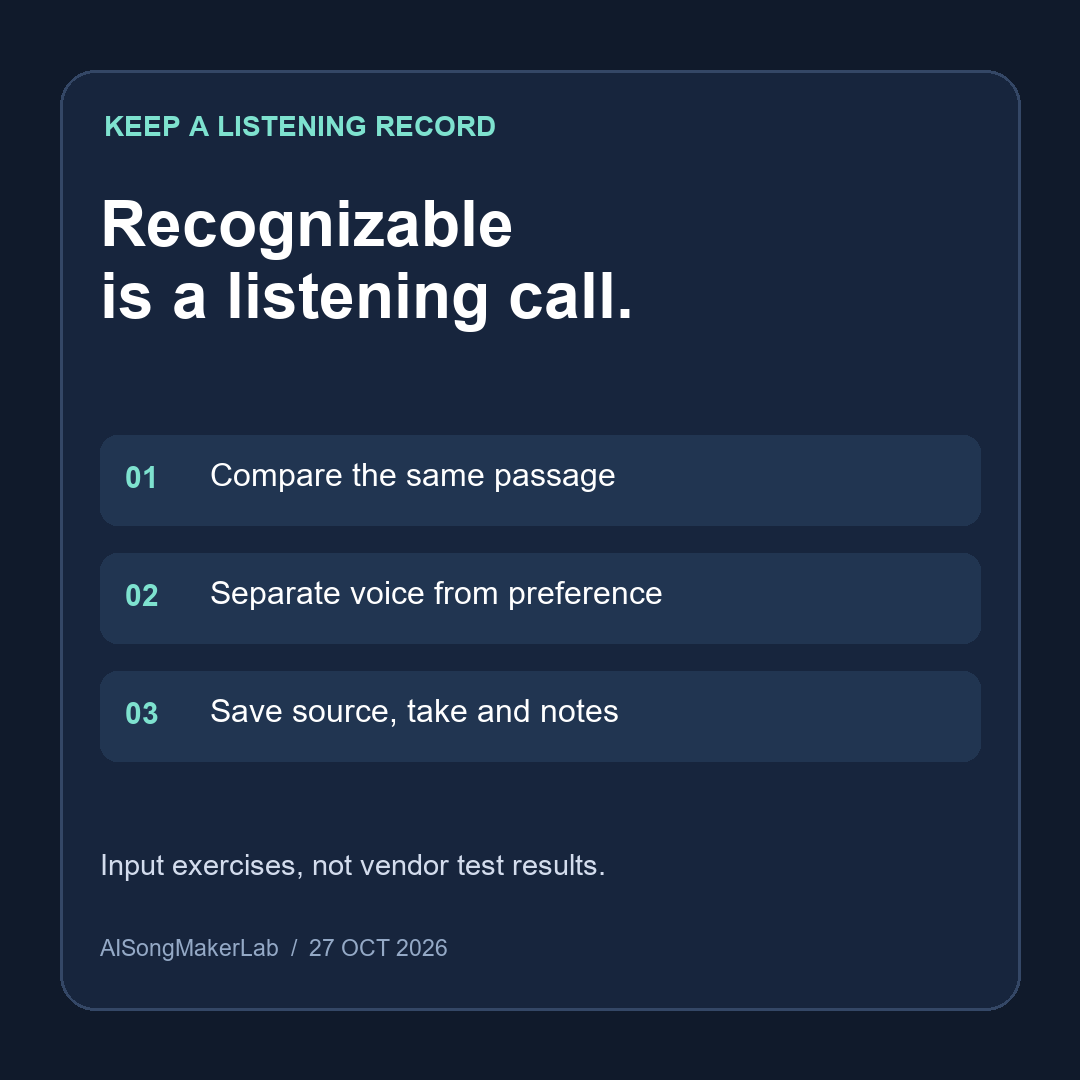
Record the source filename, what you want to preserve, the service's stated input requirement and the exact brief. After listening, record the passage you compared, whether words changed, whether the voice sounded recognizable to you, and which performance you preferred. Finish with one next change. Leave uncertain items uncertain; do not turn them into a percentage.
Once you choose a take, retain your own source, the supplied lyric, the saved output and the dated notes together. Review the service's current controls for stored voice material. Do not assume deleting an exported song also removes a separately stored voice profile; check each visible item according to the product's instructions.
Questions before choosing a generator
Does an AI song generator from lyrics use my voice?
Not merely because you supplied the words. Look for explicit personal-voice input support. Our own-lyrics guide covers the words-to-song task; this page covers the additional decision about the singer.
Is uploading audio enough?
The upload field alone does not tell you what the service does with the audio. Read the field label and current help, then compare a short result with the input. Record whether it uses melody, preserves your performance, or supports a personalized voice.
Can a voice preset count as my own voice?
A preset with a similar description is not evidence that it represents your recorded voice. Decide whether you actually need personalization or simply a singer that suits the song; those are different selection criteria.
What if my spoken voice is all I have?
Check whether speech is an accepted source for that specific workflow. Do not assume a speech input produces the same result as a sung reference. Case three gives you a listening question without promising a result.
What should I compare before paying for a longer song?
Compare your own short source with the resulting chorus, confirm that the input mode supports the task, and inspect current download access. A polished demonstration from someone else cannot answer whether your source works for your purpose.
Related: Turn your own lyrics into a song · Keep names and facts in your lyrics.
Download the five original exercises · Download your blank listening record