Best AI Lyrics Generator for a Rewrite: Keep Names and Numbers Intact

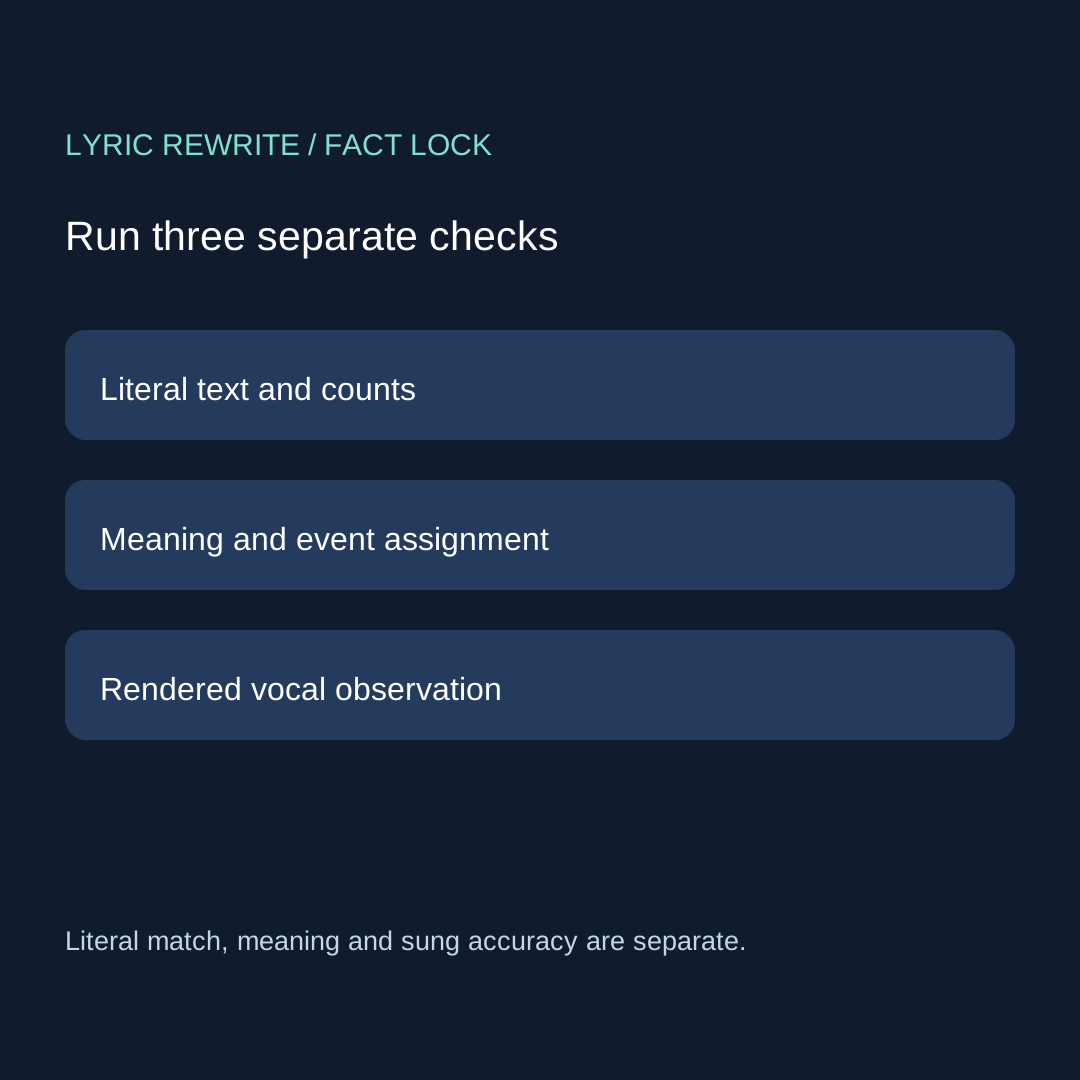
Lock the names and numbers, then check text, meaning and sung output separately. A literal match cannot prove that a value stayed attached to the right event, or that a voice sang it correctly.
Fictional brief · Five cases · Checking rule · Blank card
Define the rewrite you want to preserve
For a best AI lyrics generator selection task, start with the actual revision requirement: which words may change, and which facts must stay? This page offers an original fact-lock workflow, not a product ranking. It does not establish that any service accepts a particular name, follows an instruction or sings an unchanged line correctly.
A user's report of an unexpected lyric substitution, archived in our research on 21 October 2026, inspired the checking question. It is an individual account, not our verification of platform behavior. We do not infer an exact posting date from conflicting relative-age metadata. Our generator-selection archive also supplies a topic lead; the lyrics and practice cases below are newly authored fictional examples.
An original four-line brief
Mira Vale waits on Harbor Lane.
At 14:03 she counts seven trains.
She keeps the blue note out of rain.
By 14:10 she heads home again.
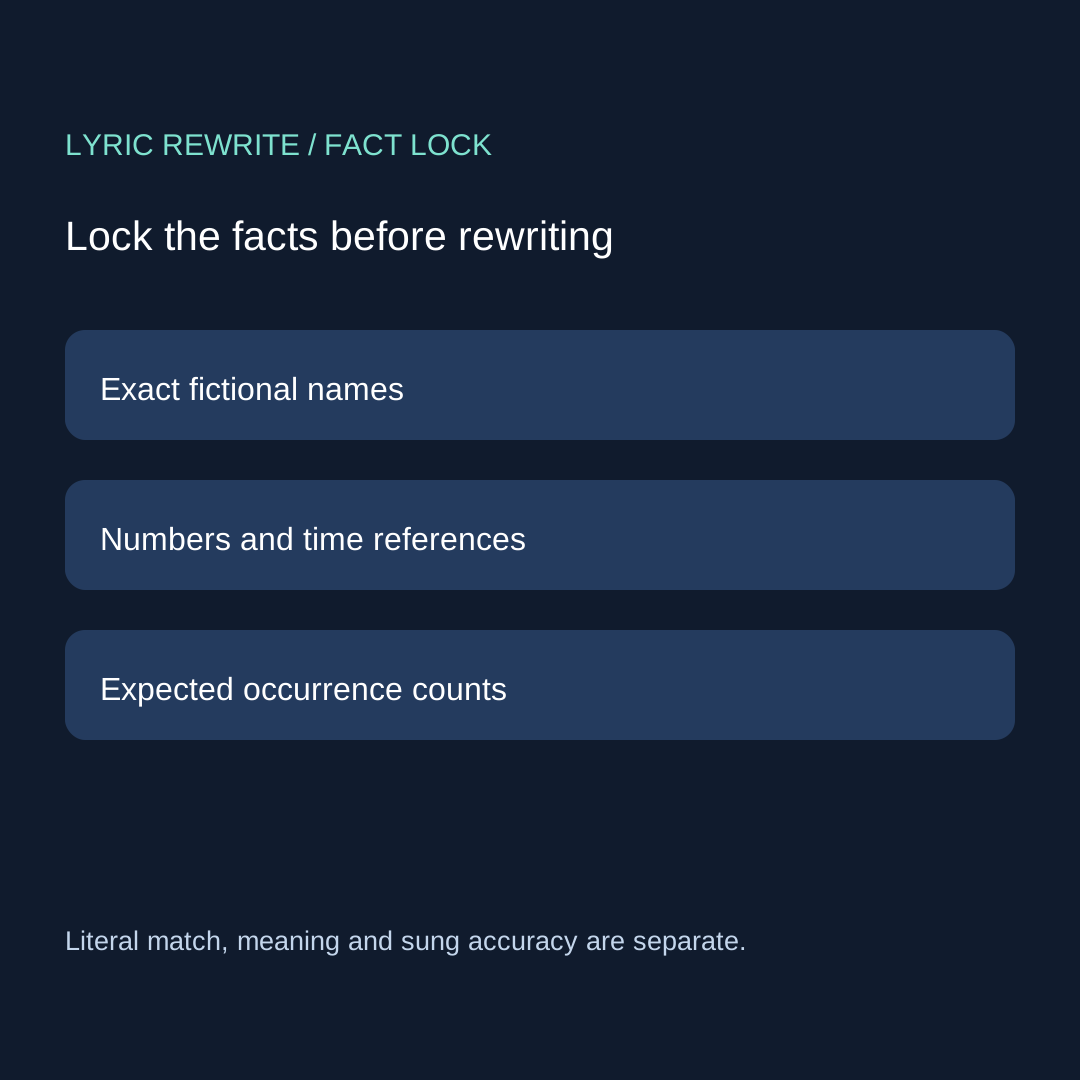
Mira Vale and Harbor Lane are invented for this exercise. The protected tokens are Mira Vale, Harbor Lane, 14:03, seven and 14:10, each expected once. The brief permits rewriting the surrounding wording, while retaining those exact tokens and the events they describe. These are two requirements: keeping the values and keeping their meaning.
Our acceptable practice revision changes waits to stands and changes the third line to She shields a blue note from the rain. The five protected values remain once each. That is an authored example of the specified edit scope, not output from a generator. It supplies no claim about improvement in melody, meter or a singer's pronunciation.
Five local checks, including a deliberate blind spot
| Authored case | Changed item | Literal-count result | Remaining question |
|---|---|---|---|
| Preserved | Surrounding wording only | Pass | Meaning and actual vocal need separate review |
| Changed count | seven becomes six | Fail | Protected value was replaced |
| Shortened name | Mira Vale becomes Mira | Fail | Exact protected name is absent |
| Extra time | An additional 14:03 | Fail | Expected occurrence count changed |
| Swapped times | 14:03 and 14:10 exchange lines | Pass | Event-time assignment violates the brief |
We executed all five cases locally. The checker uses case-sensitive exact token matching with word boundaries and compares each token's occurrence count with the draft. Its expected pass pattern is true, false, false, false, true. The full records retain every input and output, per-token counts and explicit false values for meaning_verified and sung_accuracy_verified.
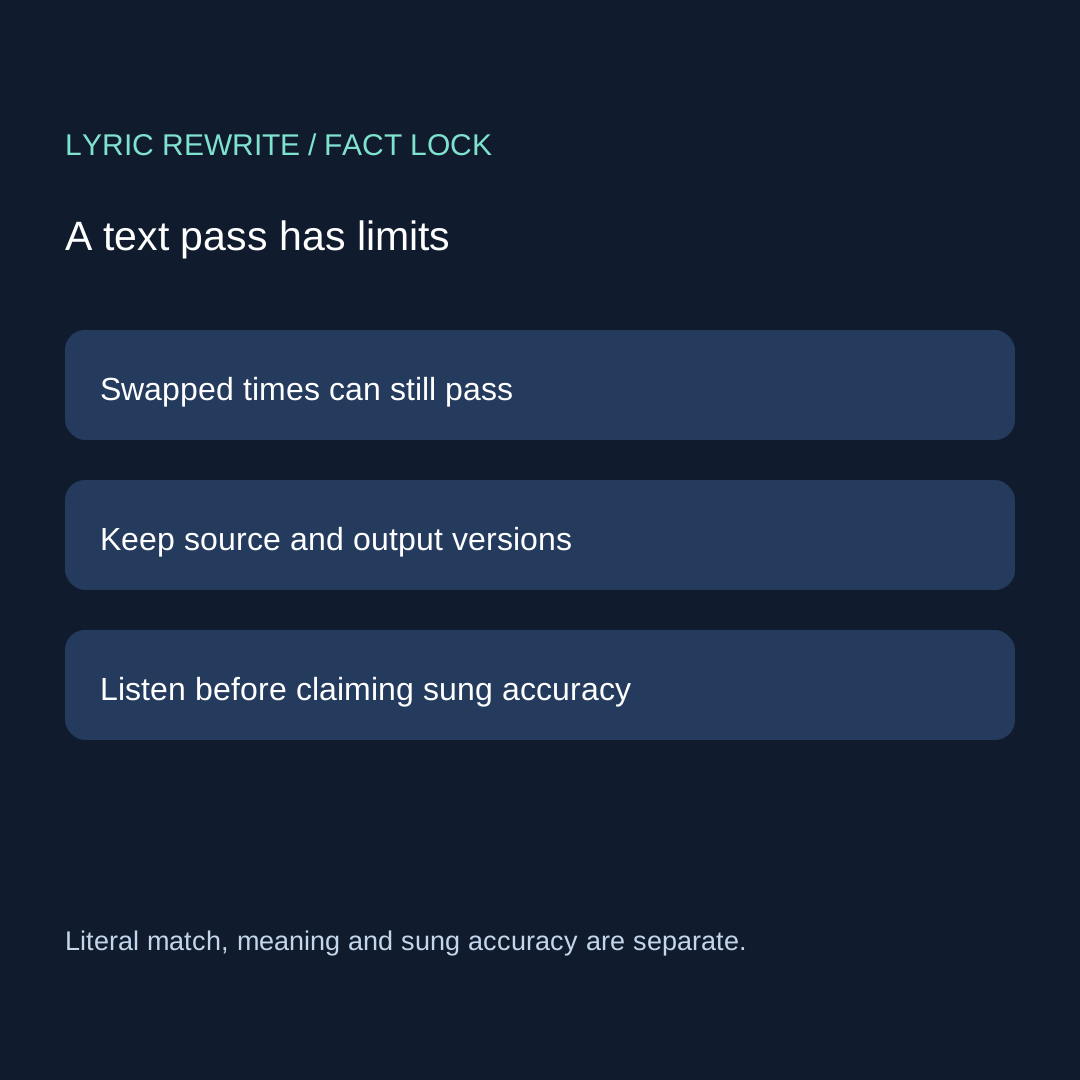
The swapped-times case is essential: a checklist can pass while the intended facts are still assigned to the wrong events. Both times remain in the text exactly once, so a literal-count check has no evidence of their roles. Read the sentence-level relationships as a separate step. Do not promote a green token result into a complete factual or musical verdict.
Keep a narrow, reproducible method
The readable standard-library Python demonstration contains only our fictional draft and cases. Run it in a new practice folder: it writes lyric-fact-results.json and replaces a same-named result there. It sends no lyrics to a service, signs into no account and performs no audio analysis. Inspect its token list before using the idea with your own material.
Exact spelling is a choice in the brief. This exercise treats Seven and seven as different. A workflow that permits capitalization changes or numeric equivalents needs a separately declared rule; it should not silently change the acceptance test after viewing the output. Similarly, allow repeated names only when the expected counts reflect that decision.
Use the fact-lock record
INPUT VERSION / OUTPUT VERSION:
PROTECTED NAME / NUMBER / PHRASE:
EXACT SPELLING / EXPECTED OCCURRENCE COUNT:
ALLOWED EDITS / FORBIDDEN EDITS:
LITERAL CHECK RESULT / DIFFERENCE:
WHO DID WHAT / WHEN / MEANING CHECK:
RENDERED VOCAL VERSION / LISTENING OBSERVATION:
UNVERIFIED ITEM / NEXT ONE-ITEM REVISION:
Download the original blank fact-lock card. Preserve the draft and output separately. When a value changes, identify that exact difference and make one requested revision. When the text passes, review who did what and when before listening to a separately identified vocal render.
For the vocal check, record what you actually heard at the relevant passage. If no render exists, write not checked. Do not fill the sung field from the displayed lyric text. A generated result might require another review, but this article contains no generated audio and makes no claim that a text instruction guarantees sung pronunciation.
Choose the next check by the problem
For narrator and timeline consistency across a whole lyric, use the story-reference card. For phrasing length use the singable-line guide. For where sections repeat use the section-order record. Our fact-lock card handles the smaller change-control problem: protecting explicitly named values during a rewrite.
Four questions from the substitution problem
Does a protected-word instruction prove the name survived?
No. Compare the saved output with the protected list and its counts. The instruction records intent; it is not an observed result.
Does the checker catch a number assigned to the wrong event?
Not necessarily. The swapped-times case passes because both exact values remain once. Review the event assignments separately.
Does unchanged lyric text prove the voice sang it accurately?
No. Preserve an actual render identifier and a listening observation. If no audio was checked, keep sung accuracy unverified.
Can I call a single user's report a verified product defect?
No. Attribute the report and keep its limits. Our invented examples verify the local checking method only; they do not reproduce the poster's service behavior.