Free AI Song Generator: Check Section Order and Repeat Counts
Check section order and repeat counts separately. Two choruses can appear in the wrong places. Write the intended sequence, timestamp the passages you can support and keep uncertain labels unknown before choosing one revision.
Watch the section order check
Define the unit · Four cases · Listening record · Blank card
Start with one arrangement question
For a free AI song generator workflow, write the intended section sequence before judging whether a take follows it. A recognizable chorus somewhere in the song does not answer whether the chorus arrives in the intended place or repeats the intended number of times. This card separates those questions without ranking tools or promising any free-plan capability.
The topic begins with a generator-selection question in our materials archive. We wrote the sequence examples, comparison rules, blank card and small checker ourselves. The examples below are declared label lists, not a generated song, an audio recognition result or a vendor test. A match in this demonstration says only that the supplied lists agree.
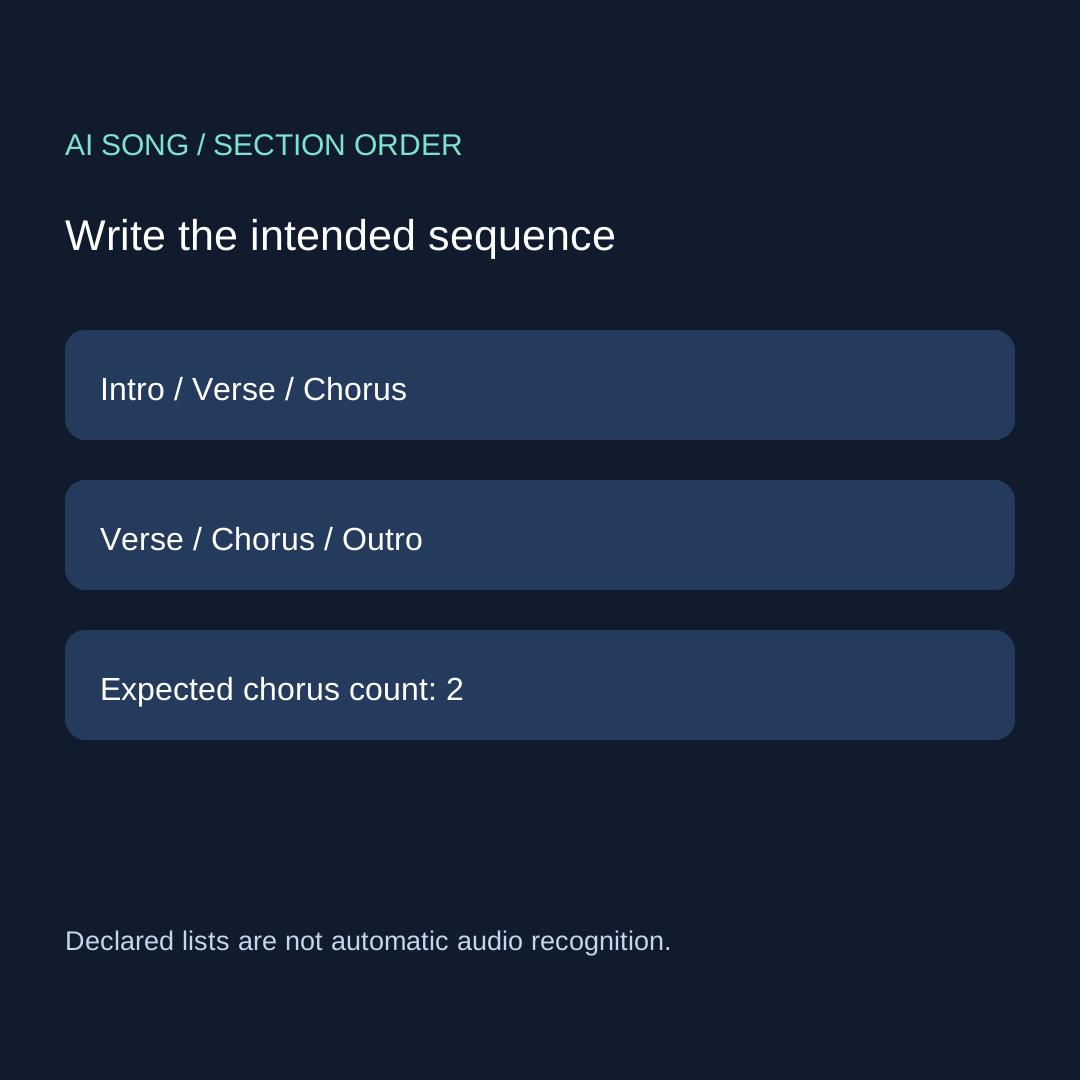
Write the labels and the repeat unit
Our authored example brief is Intro → Verse → Chorus → Verse → Chorus → Outro. It has six section occurrences and two occurrences labelled Chorus. This does not mean two unique chorus melodies or two lyric lines. Define the unit first: a whole section occurrence, a repeated lyric phrase and a repeated audio loop are different things.
Use working labels that fit the task. If a passage is a refrain within a verse rather than a separate chorus, record that interpretation. Do not force a bridge label onto an unclear transition just to complete a template. Write the ambiguity and what you would need to hear or inspect before deciding. A useful record can contain unknowns.
Four constructed cases expose different failures
| Declared case | Sequence | Chorus count | Result |
|---|---|---|---|
| Match | I V C V C O | 2 | Counts and order match the supplied brief |
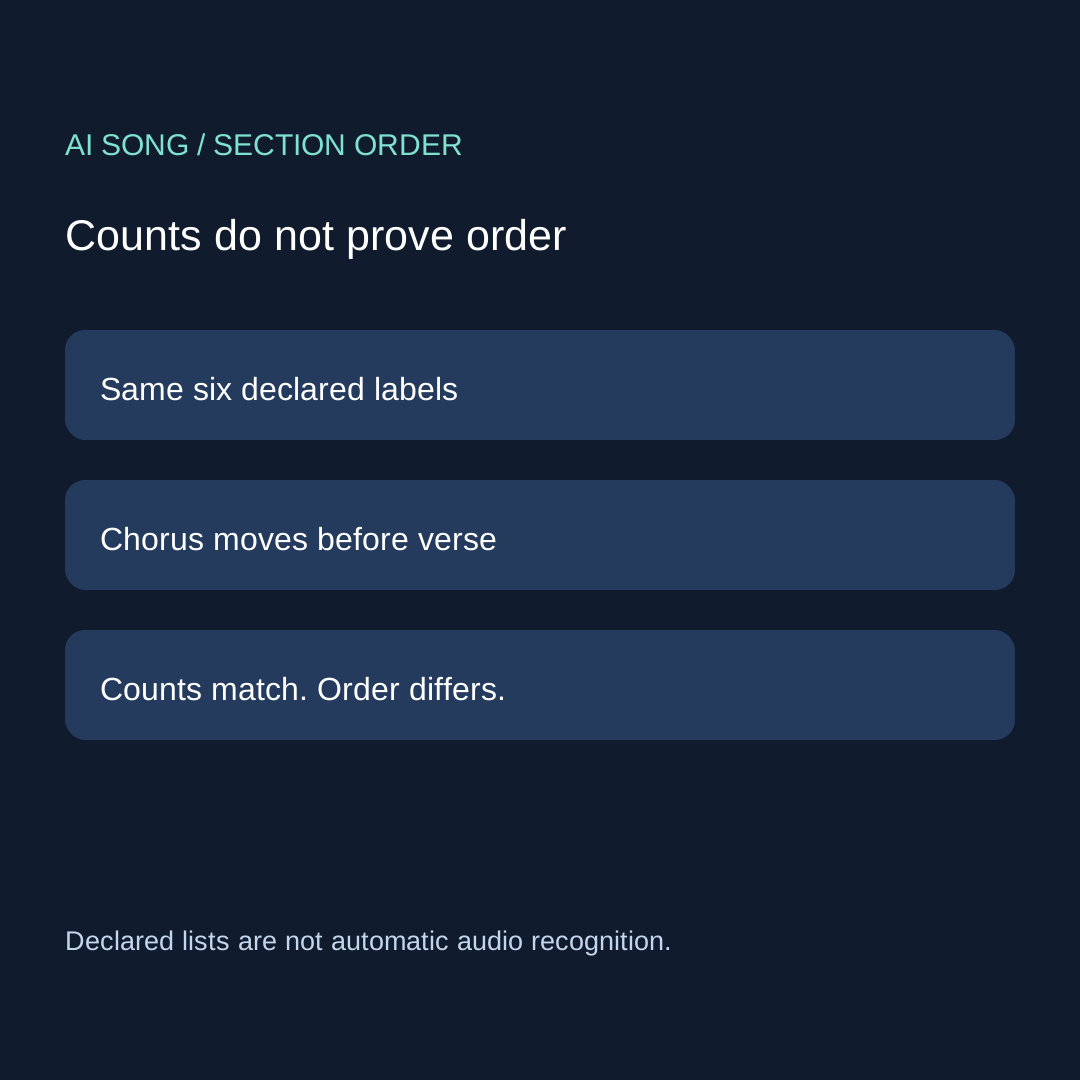
| Reordered | I C V V C O | 2 | Counts match, order differs at position 2 |
| Extra chorus | I V C V C C O | 3 | Length and chorus count differ |
| Unresolved | I V ? V C O | 1 confirmed label | One passage is unknown; no complete arrangement verdict |
I, V, C and O abbreviate the four labels in this example only. The unknown case does not establish that a song has only one chorus. It establishes that the declared list contains one confirmed chorus label and one unresolved passage. Resolving the passage might change the count. Keep confirmed counts and unresolved ranges in separate fields.
We executed these comparisons locally using Python's standard-library Counter and direct list equality. For the reordered case, Counter(expected) equals Counter(observed), while expected equals observed is false. No signal processing, musical segmentation or model inference was performed. The full four-case records include the supplied lists, first differing position, count result and audio_inspected set to false.
Apply the card to a real take without inventing certainty
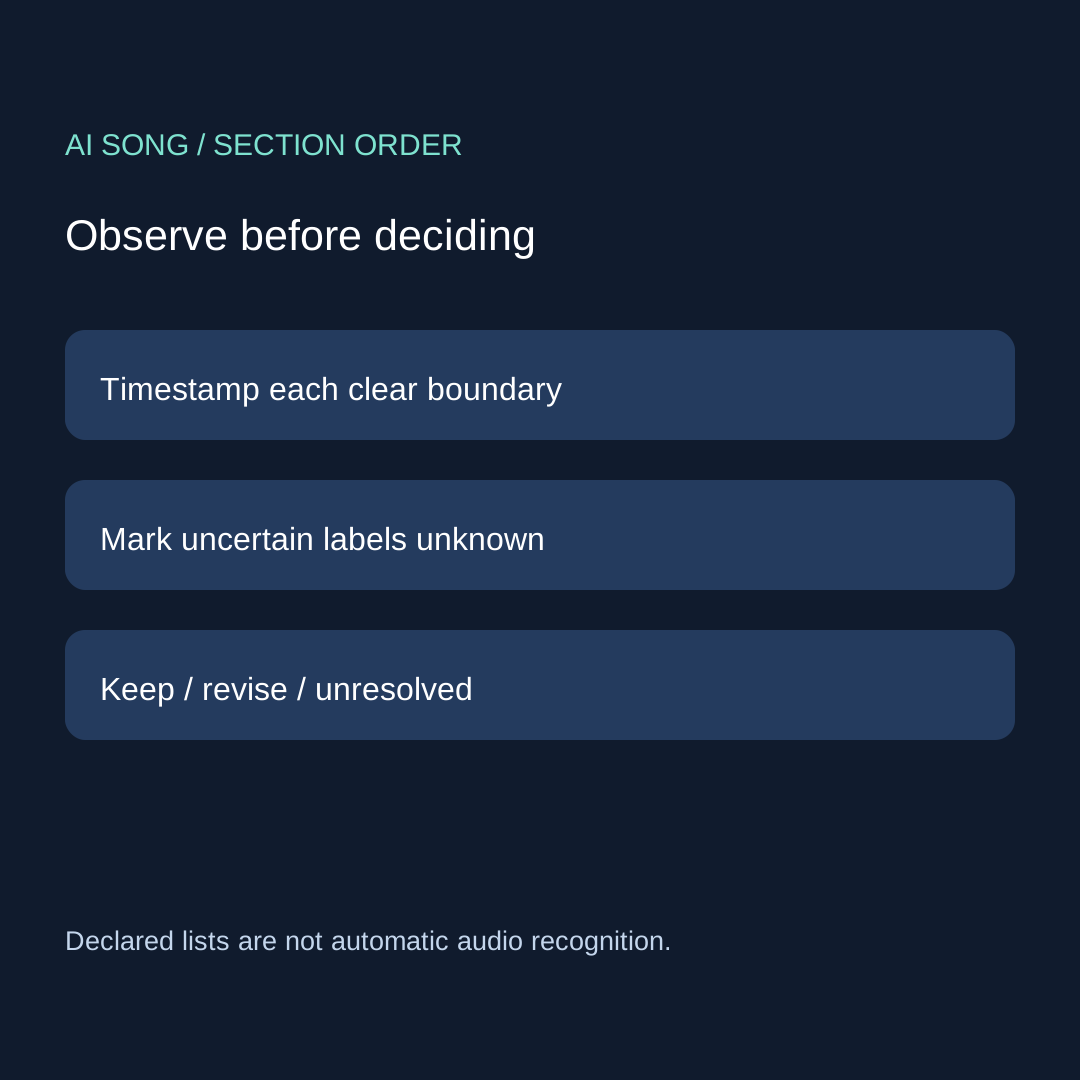
Keep the exact take filename or version reference and a copy of the intended arrangement. Listen from the beginning, writing a tentative start and end time for each passage. Record the evidence for the label: the words returning, a clear sectional change or a creator-supplied marker you actually inspected. A marker is a claim to check, rather than proof that the audio follows it.
Replay each uncertain boundary with the same player and note which timing display you used. Do not manufacture frame-accurate timestamps from an approximate progress bar. If the passage could reasonably belong to either neighboring section, retain an unresolved interval. The card's goal is a usable revision decision, not a forced complete transcription.
Once labels are supported, compare occurrence order from left to right and count each label separately. If one section is extra, record that occurrence and its time range. If the order differs, record the first difference and the surrounding passages. Matching counts alone do not establish matching order; matching order of coarse labels does not establish matching lyrics, melody or duration.
Download the original section card
TAKE / EXACT FILE / VERSION:
EXPECTED LABEL SEQUENCE:
EXPECTED COUNT FOR EACH LABEL:
OBSERVED TIME RANGE / LABEL / BASIS / CONFIDENCE:
UNKNOWN OR DISPUTED RANGE:
FIRST DIFFERENCE / AFFECTED REPEAT:
SEPARATE FILE / RIGHTS / DOWNLOAD CHECKS:
DECISION: keep / revise one item / unresolved
Blank section-order card · Readable declared-list demonstration. The demonstration needs Python 3, reads no audio and writes no files. Inspect its two lists and change a copy for your own declared sequence. It cannot determine which labels a real song deserves.
Make the next action specific
If an observed chorus appears too early for the brief, name the intended change and preserve the current version before using a supported edit or another generation. Check the resulting take again instead of assuming the instruction was followed. If the workflow offers no sectional editing, record that limitation; this article does not establish any service's current editing entitlement.
For choosing between whole takes, use the version comparison record. For a finished ending, use the ending checklist. For keeping an editable session and its sources, use the reopen-and-recover card. This page's decision is narrower: do the supported section labels follow the intended order and repeat count?
Four questions from the selection workflow
Do two choruses prove the arrangement is right?
No. Our declared reordered example retains two chorus labels but changes their position. Check both the supported labels' sequence and their counts.
Can this checker listen to my generated track?
No. It compares lists supplied by a person. Our executed examples contain no audio analysis, and the retained records explicitly mark audio as uninspected.
What if I cannot label one passage?
Record its time range and mark it unknown. Report confirmed counts separately; do not convert an uncertain label into either a missing or an extra section.
Does passing this card establish download or commercial rights?
No. Arrangement evidence and file access or licensing are separate checks. This worksheet records structure; it supplies no entitlement or rights determination.