AI Song Maker Free: A Reopen-and-Recover Session Checklist
Keep the project reference, source assets and state notes, then verify an actual reopen separately. A playable mix or a matching file hash alone is not proof of a recovered editing session. Preserve originals and mark partial evidence as partial.
Watch the session recovery check
Four records · Practice bundle · Executed checks · Blank card
Choose a recovery question you can answer
If you use an AI song maker free workflow, a playable export is useful evidence of that file, but it does not establish that you can resume the editing session. Our original reopen card separates the project reference, source assets, recorded settings and an actual editor-reopen observation. It supplies no free-plan entitlement or cloud-autosave guarantee.
A generator-selection question in our material archive supplies the topic lead. We authored a local practice bundle and asset checker for this article. This is not a native DAW project, an account backup or a recovered vendor session. No music service was tested, and no claim about a current search-results top ten has been established.
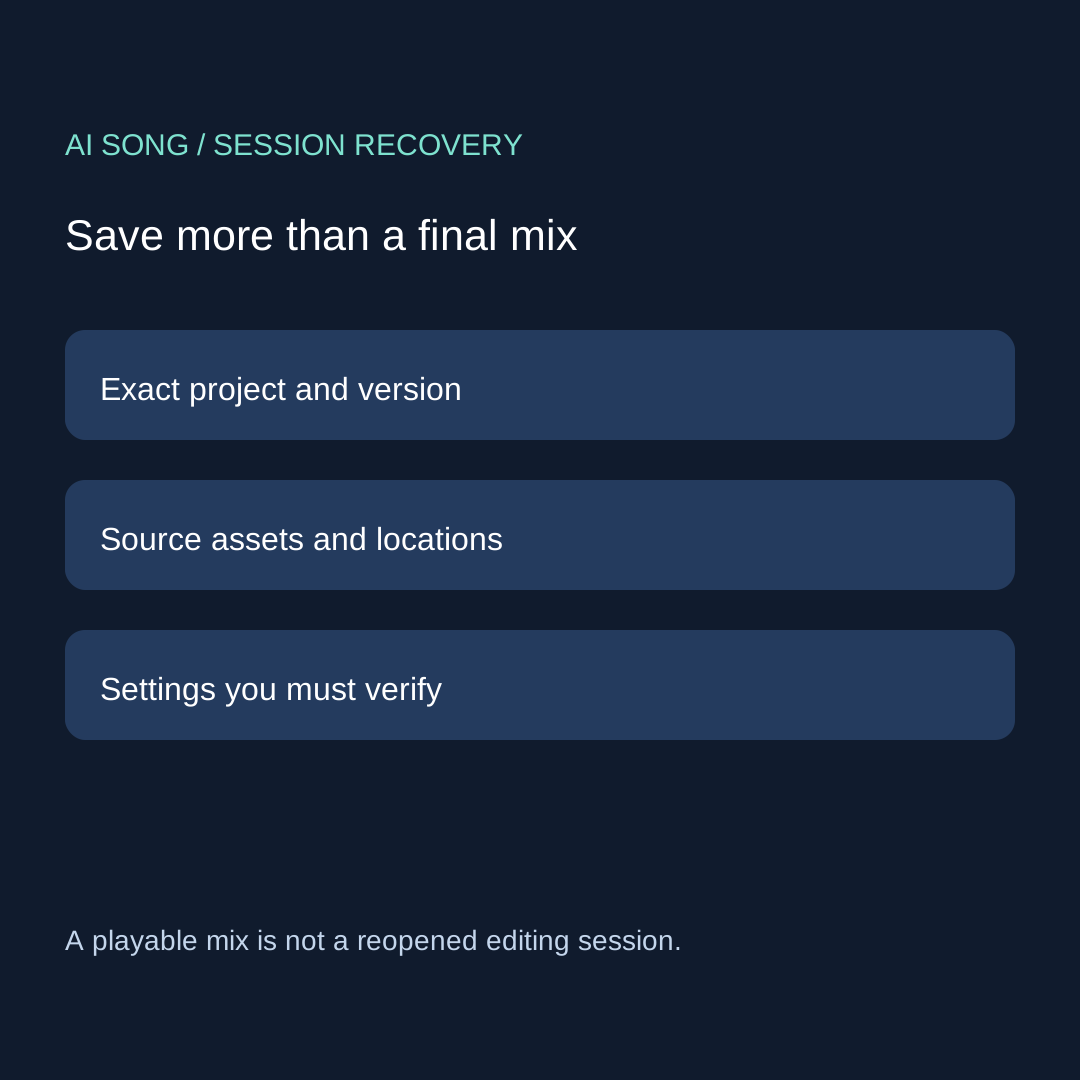
Keep four records separate
| Record | Example to retain | What it cannot prove alone |
|---|---|---|
| Project reference | Exact project filename or workspace identifier and version | That its sources are still available |
| Asset inventory | Source filenames, relative locations and permitted copies | That track settings are restored |
| State note | Track name, source, offset, mute and gain as actually observed | That an editor loaded those values later |
| Reopen observation | Which project opened, what loaded and what played | That another version or account will behave the same way |
Use only projects and assets you are authorized to copy. Before leaving a real session, use its supported save operation and note the exact result. Preserve the original project and a named copy where supported. Do not close the only unsaved session to run an experiment; this article's downloadable exercise can be checked separately without touching your working project.
An original local practice bundle
Download the recovery-record practice ZIP. It contains manifest.json, practice.wav, notes.txt, a readable Python checker and a README. The manifest names two expected assets and their SHA-256 hashes. Its example state records a practice track, a zero-second offset, linear gain one and mute false. Those are authored record values, not settings observed inside an editor.
The audio is a one-second, mono, signed 16-bit PCM signal at 24,000 samples per second. We constructed its 24,000 samples as int(4000 × sin(2π × 330 × n / 24000)), with n from zero to 23,999. It is not a generated song or a commercial recording. The plain-text note is also written for this exercise.
Unzip the bundle to a new folder. If you have Python 3.9 or later, read the included script and run python verify_session.py in that exercise folder. It reads the manifest and named local assets, writes nothing and rejects paths outside the exercise folder. The standalone checker source is available separately for inspection. It installs no packages and does not open a music application or sign into any account.
Three locally executed checks, with their limits
We ran the checker in three separate practice folders. The intact case was extracted from the published bundle. The missing case was constructed without the practice audio file. The changed case retained that audio and deliberately replaced the practice note. No original working project or source asset was deleted or modified to create these cases.
| Constructed case | practice.wav | notes.txt | Checker exit |
|---|---|---|---|
| Intact bundle | Present and hash matches | Present and hash matches | 0 |
| Missing audio | Missing | Present and hash matches | 1 |
| Changed note | Present and hash matches | Present, different hash | 1 |
The retained result records expose expected and actual hashes, per-file status, exit code and the authored state note. All three records explicitly say editor_reopened is false. Passing the asset check means the named files match the saved inventory. It does not prove a project opened, a plugin loaded, a timeline was restored or an account retained a workspace.
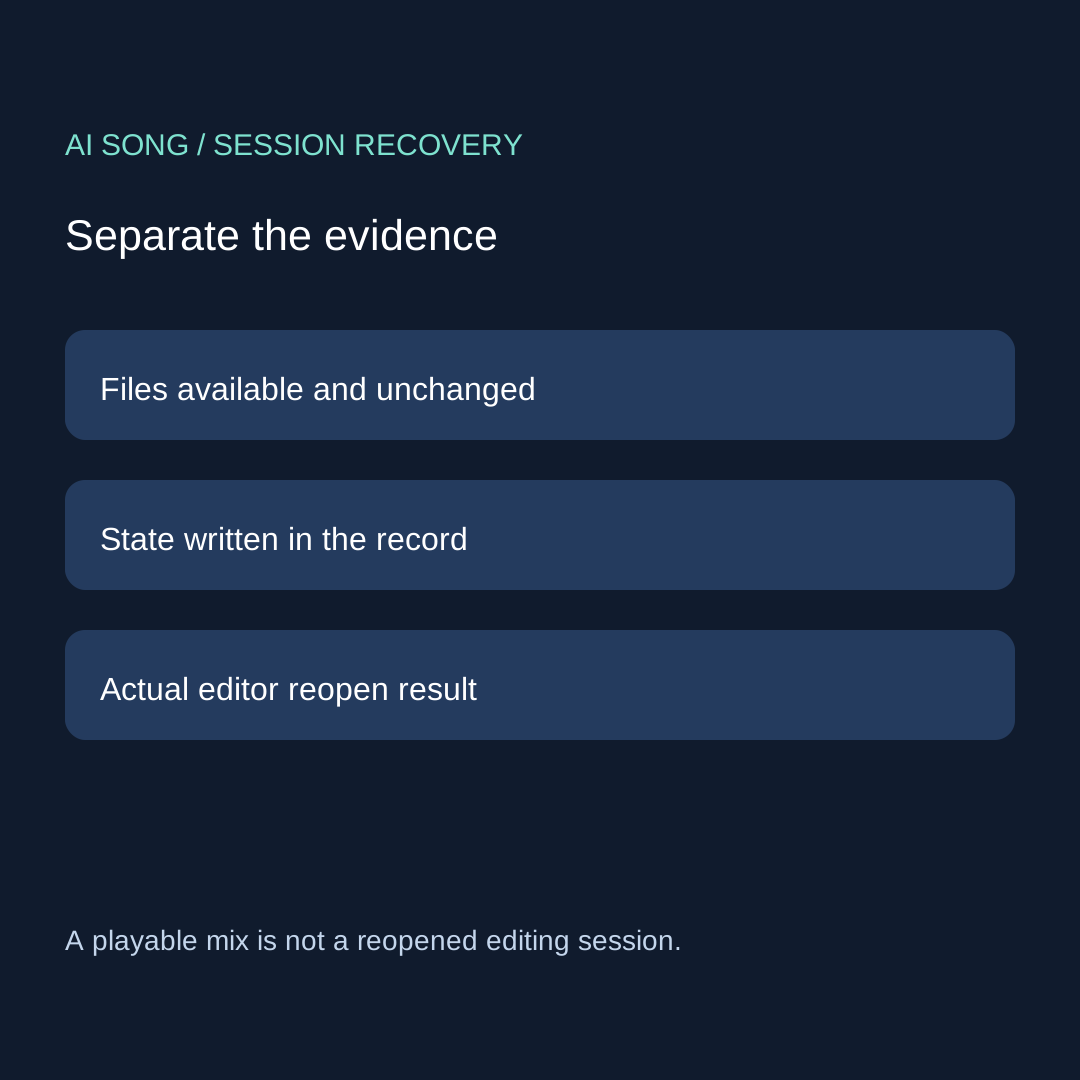
The original reopen-and-recover card
DATE / WORKFLOW / EXACT PROJECT REFERENCE:
SAVED VERSION / CONFIRMATION OBSERVED:
SOURCE ASSET / LOCATION / PERMITTED COPY:
RECORDED TRACK / OFFSET / MUTE / GAIN:
OTHER SETTINGS NEEDED / NOT RECORDED:
REOPENED PROJECT / VERSION OBSERVED:
MISSING OR CHANGED ASSET:
STATE VALUE ACTUALLY CHECKED AFTER REOPEN:
PLAYBACK PASSAGE / OBSERVATION:
UNRESOLVED DEPENDENCY OR ACCOUNT CONDITION:
DECISION: recovered / partial / stop unresolved
Download the blank recovery card. For a real project, fill only what you observed. If your workflow provides no editable project export, record that limitation rather than calling a mix download a project backup. If a setting has not been checked after reopening, keep it marked unverified even when its old value appears in a note.
Use partial when only part of the session is accounted for
In an authored hypothetical case, an exported mix plays, the project reference exists and one source file is missing. That is not a verified full recovery. Name the missing dependency, retain the playable mix and investigate a supported relink or recovery option without overwriting the original. A filename that looks familiar is not enough to identify the intended version.
For export identity, use the saved-file evidence guide. For choosing between candidates, keep the version comparison record. This recovery card asks a different question: can you resume the intended work with the required sources and state, and what evidence have you actually checked?
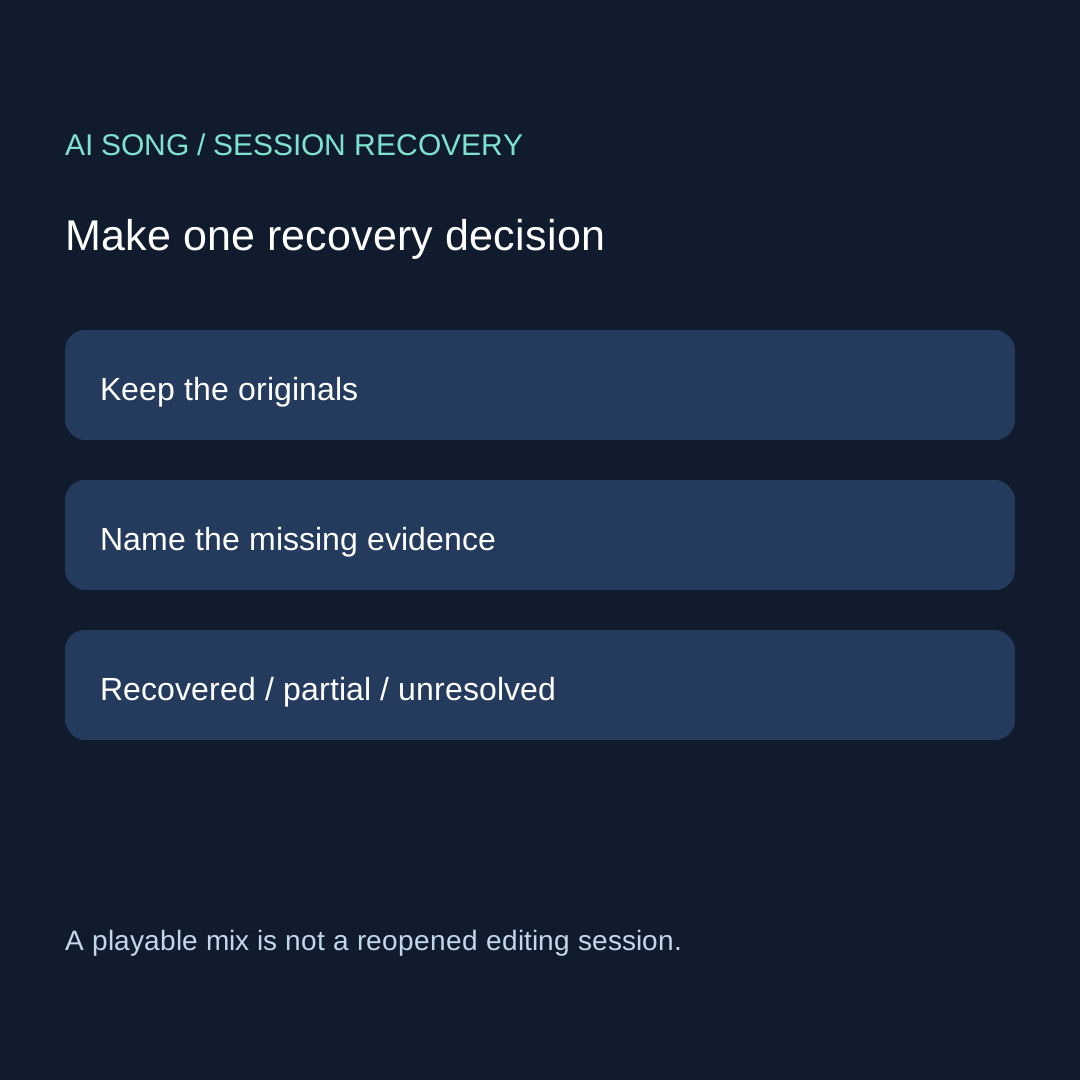
Four questions from the generator-selection task
Does a downloaded mix prove my editing session is safe?
It establishes only what you verified about that file. Project state, sources and account-dependent workspace behavior require separate evidence. No service's retention behavior was tested in this exercise.
Does a matching asset hash prove the project reopened correctly?
No. The checker compares local file bytes with the manifest. It does not inspect a music application's timeline, processing or playback. Keep an actual reopen observation separate from an asset-check result.
Should I delete or rename a real source to test recovery?
This method uses new practice folders instead. Preserve the working original and follow supported save or copy operations. A recovery exercise should not put your only active session at risk.
What if the account or workspace cannot be reopened?
Record the exact unresolved access or dependency condition and retain the versions you can identify. The local practice bundle cannot restore a cloud account. Do not label the session recovered until the required checks actually pass.