Best AI Lyric Generator for a Clear Story: Track Who Speaks and When
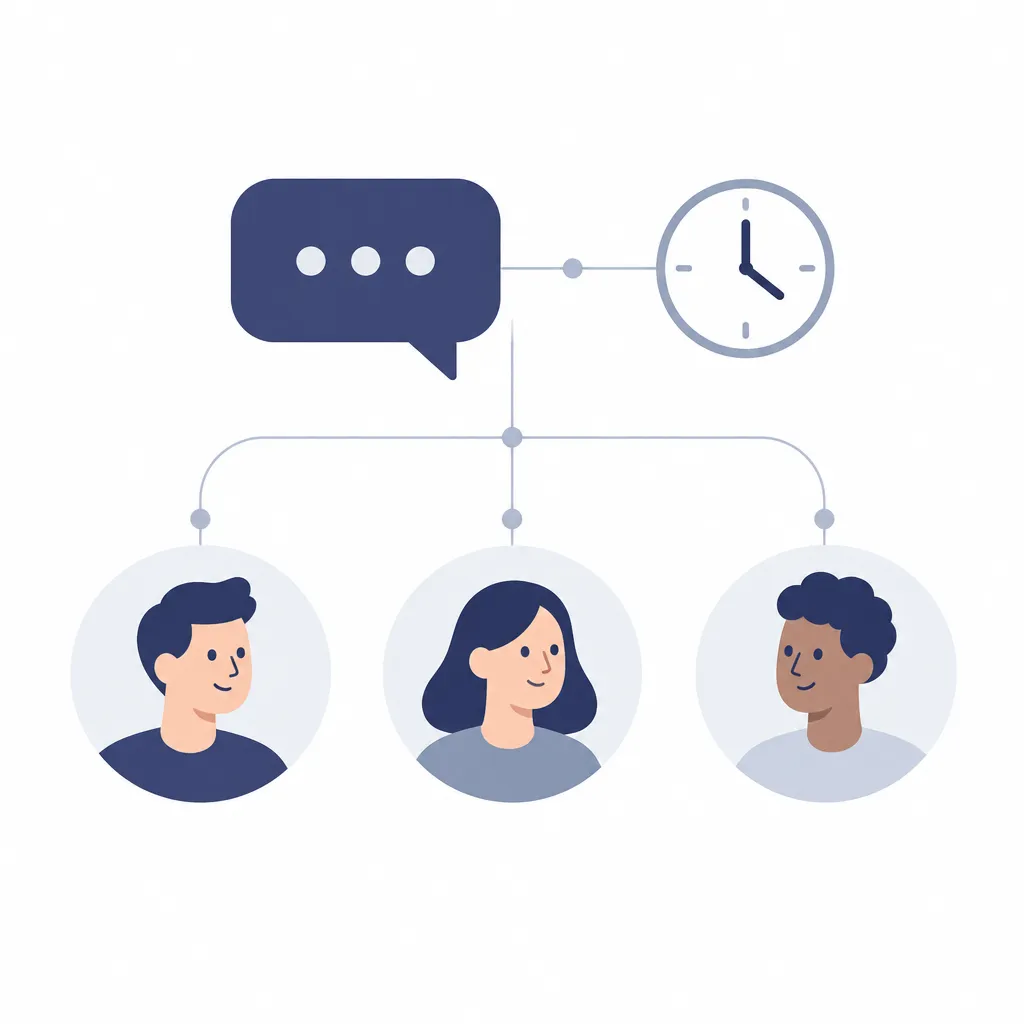
Check who speaks, when events happen and who each reference means. Write a short story brief, compare one lyric line at a time and record any meaning changed by a revision. Choose the candidate that fits your intended story before judging rhyme or singability.
Watch the lyric story check
Story brief · Eight-line revision · Story card · Acceptance rule
Define the story before choosing the rewrite
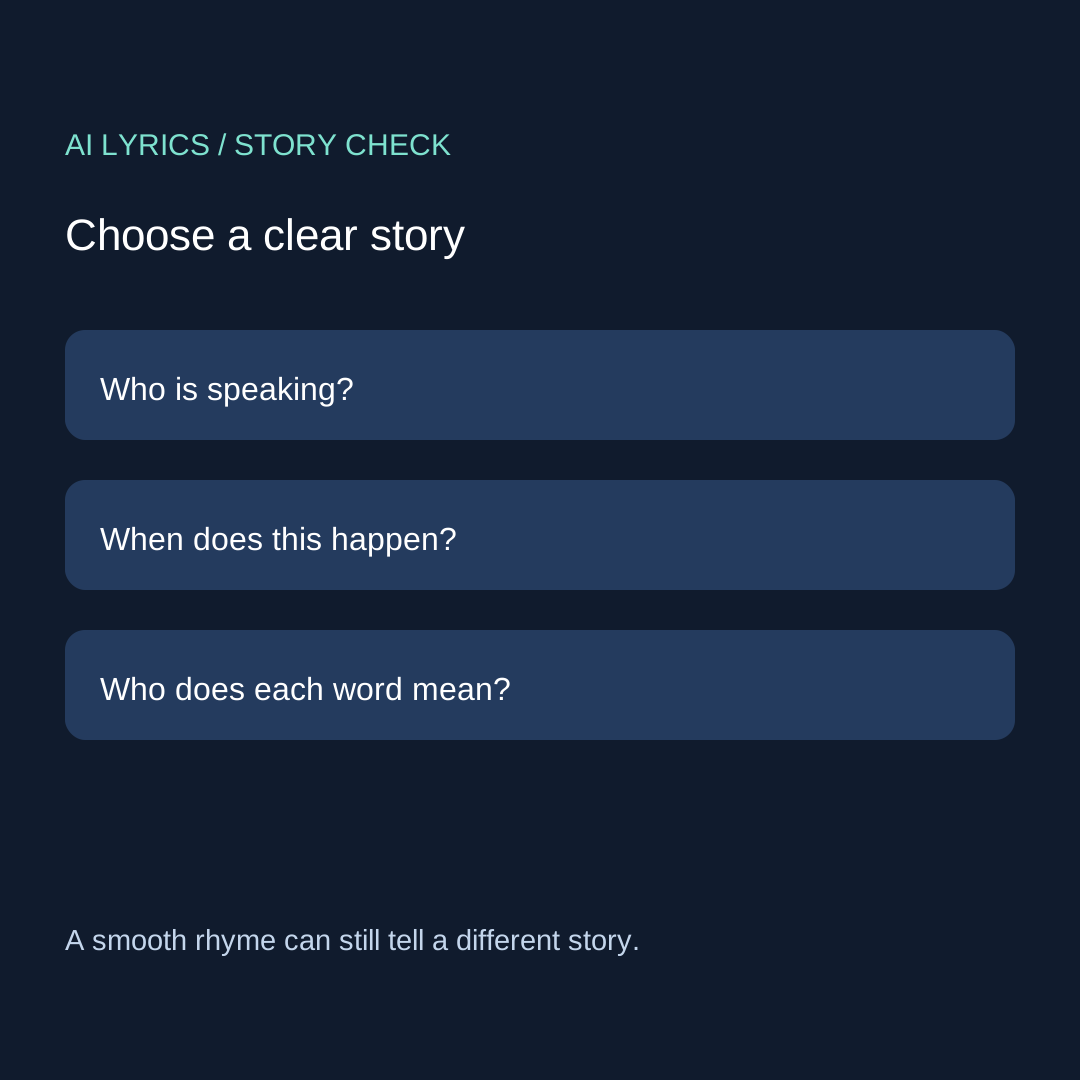
For this task, the best AI lyric generator is a workflow that helps you revise a specific story mismatch while preserving the meaning you chose. A fluent verse is not automatically the right verse. Before comparing candidates, write who speaks, who is addressed and when each event happens. Then check the saved text against that brief.
A generator-selection question in our material archive supplies the topic lead. Our contribution is an original story worksheet and an authored eight-line revision, not a vendor ranking. We did not submit these lines to a service or test a model. Both versions were written for this lesson; they are not a user's quotation, a commercial song or evidence of a generator's behavior.
A small brief that makes a comparison possible
For the exercise below, the speaker is one person recalling a departure and a reunion. The word you addresses that person's friend. The friend's sister is a separate character. The departure comes first, waiting comes the next morning and the reunion comes later. The story is told as a remembered sequence in the past. Those are our chosen editorial constraints, not universal songwriting rules.
A different song might deliberately switch narrators, mix times or leave an identity unresolved. Such choices are allowed. Mark them as intentional in the brief so you can distinguish them from an accidental rewrite. The purpose of the worksheet is to preserve your intent, not to remove every ambiguity or force every lyric into one tense.
Eight authored lines, with the reason beside each change
The first version deliberately contains references and time choices that do not meet our brief. The revision chooses one coherent interpretation. It also changes some events, so it must be treated as an editorial proposal rather than a meaning-preserving correction in every line. Read the reasons before deciding whether you would accept those changes.
| Line | Authored draft | Authored revision | Editorial reason |
|---|---|---|---|
| 1 | I left a light beside the gate. | I left a light beside the gate. | Keep: the speaker sets the departure scene. |
| 2 | You watched the last train disappear. | You watched the last train disappear. | Keep: you is the friend addressed throughout. |
| 3 | She folds the note I wrote that night. | You held the note I wrote that night. | Revise: unnamed she and present tense conflict with this brief. |
| 4 | Tomorrow he was waiting here. | Next morning, I was waiting here. | Revise: name the speaker and use the intended later event. |
| 5 | I tell the rain we stayed too late. | I told the rain we stayed too late. | Revise tense for this single remembered sequence. |
| 6 | Your sister says that I should go. | Your sister said that I should go. | Revise tense; sister remains a separate character. |
| 7 | He keeps her ticket by the door. | I kept your ticket by the door. | Revise: assign ticket holder and owner explicitly. |
| 8 | We wait where only she would know. | We met beside the gate we knew. | Revise: replace an unassigned reference with the intended reunion. |
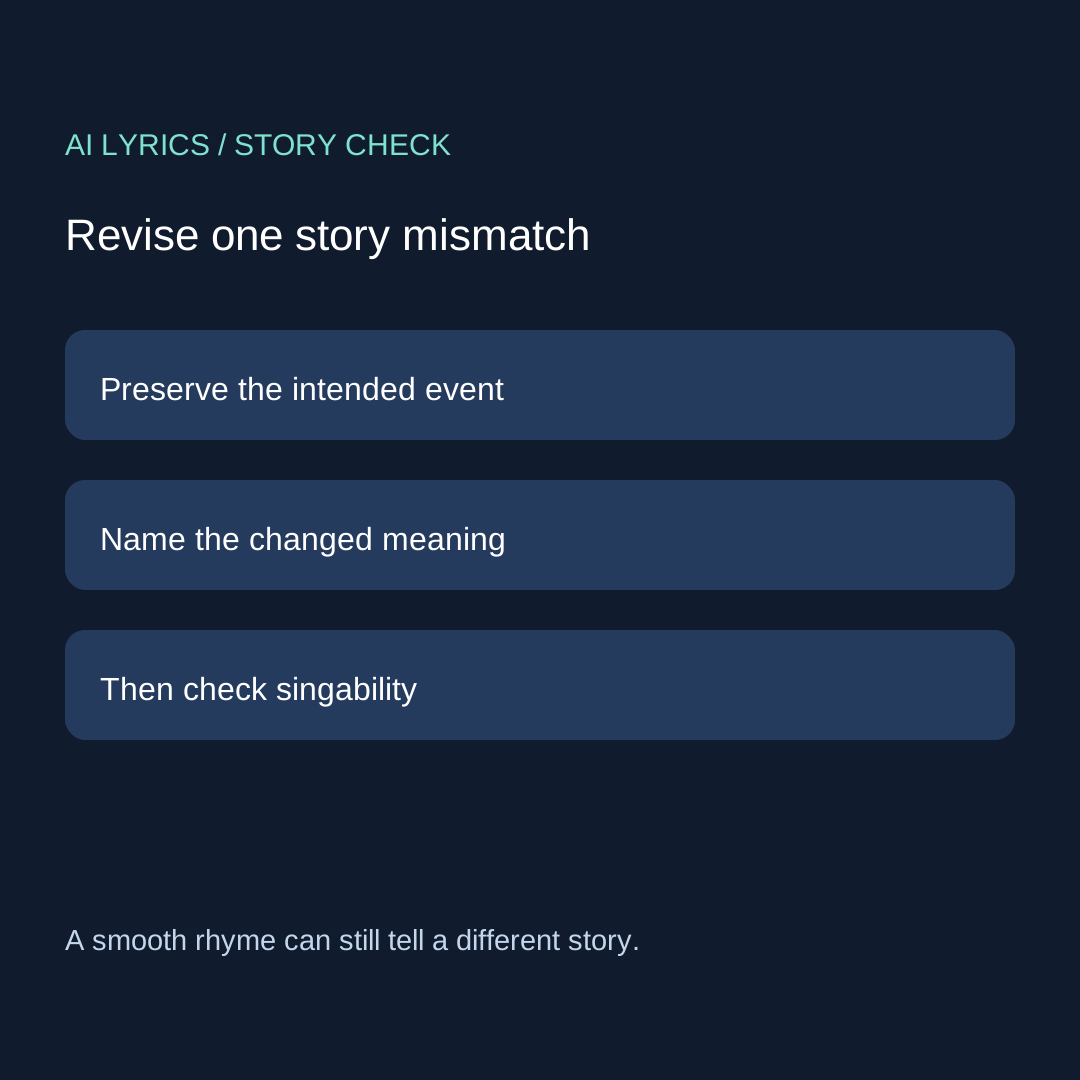
Download the line-by-line revision table. In line three, she might have been meant as a new character. Our brief instead requires the friend, so the revision uses you. If she was intentional in your own song, retaining or introducing that character could be the better choice. The worksheet cannot infer your intention from a pronoun alone.
Line four changes both the unnamed person and the time expression. That is a meaningful intervention, not just a grammar adjustment. Line eight replaces an unknown person's private knowledge with an explicit reunion at the gate. Accept that new event only if it matches the story you want. A more readable line can still fail a requirement to preserve the original event.
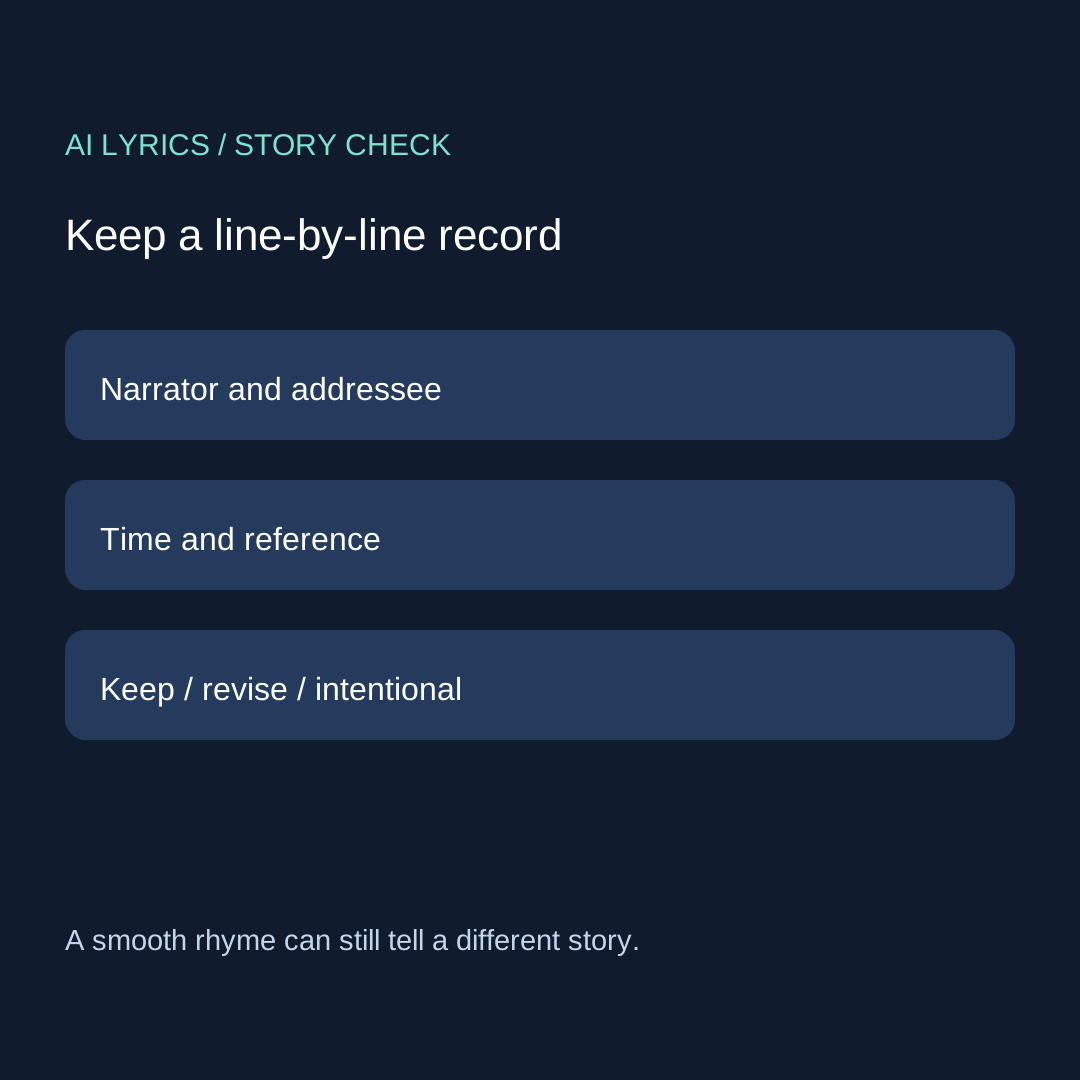
Use one row per line
STORY BRIEF / VERSION:
SPEAKER OR PLANNED SPEAKER CHANGES:
ADDRESSEE / OTHER CHARACTERS:
EVENT ORDER / INTENTIONAL TIME SHIFTS:
LINE NUMBER / EXACT TEXT:
WHO SPEAKS / WHO IS ADDRESSED:
TIME OF THIS EVENT:
PRONOUN OR REFERENCE / INTENDED PERSON:
MISMATCH OR INTENTIONAL CHOICE:
ONE REQUESTED REVISION:
MEANING CHANGED / ACCEPTABLE OR NOT:
DECISION: keep / revise / unresolved
Download the blank story card. Start with the lines that make you hesitate. Write unresolved where you cannot assign a reference. Do not invent a character simply to fill an empty box. Then compare adjacent lines: a reference may be clear locally but conflict with the preceding event or a later chorus.
An original revision instruction you can adapt
Use the attached story brief. Identify one line where narrator, time or reference conflicts with that brief. Quote only that line from my supplied text, explain the mismatch and propose one revision. State any event or relationship your revision changes. Keep intentional ambiguity marked in the brief. If the intent is missing, ask rather than inventing it.
This is an authored instruction template, not a guarantee that any model will follow it. Use only text you are authorized to submit, review the workflow's displayed conditions and keep the original locally. Save the returned version under a distinct name. A conversation summary is not an adequate substitute for the exact candidate you are judging.
Compare meaning before accepting fluency
For each proposed change, record two separate decisions: does the new line meet the story brief, and does it preserve the meaning you wanted to keep? If it meets the brief by inventing an unwanted event, reject or revise that proposal. If both versions express the intended story, you can then compare phrasing, rhythm and rhyme on their own terms.
After the story check, use the singability worksheet for line length, stress and delivery. That is a separate task. This article does not claim that its revised verse has been sung successfully. For multiple candidates, retain version names and use the version comparison guide instead of judging from memory.
Four questions from the generator-selection task
Can a grammar correction change my story?
Yes, in an editorial proposal it can. Replacing a pronoun may assign an action to a different character, and changing a time phrase may reorder events. Check the intended person and event beside the smoother wording. Our authored lines three and four show those choices, not observed model errors.
Should every line use the same narrator and tense?
No. This exercise chooses a single remembered sequence to make its comparison explicit. If your song deliberately switches voice or time, mark the switch and its intended position in the brief. Judge consistency with that plan rather than treating variation itself as a mistake.
Does a clear story mean the lyric will sing well?
No singing result has been tested here. Story clarity, delivery and musical setting are different acceptance questions. Keep the text version that meets your story requirement, then make a separate authorized singing or generation test and record what actually happened.
What if I cannot tell who a line refers to?
Keep it unresolved until you choose the intended reference. Compare the neighboring lines and your brief. Investigate a control label with the task glossary when needed. Do not spend another generation attempt without naming the uncertainty it should resolve.