Top AI Music Generator: Record Playback Level Before Comparing Takes

Compare exact files and the same passage with a documented level procedure. Keep originals, record any gain and distinguish sample measurements from perceived loudness. Choose against the musical task you wrote down, not an unexplained playback difference.
Watch the playback level check
Comparison conditions · Practice files · Measurements · Blank card
Define the comparison before naming a winner
A top AI music generator for your task should be chosen from evidence about the result you need, not an unexplained preference between two playback conditions. This original card records file identity, passage, playback setup and any level adjustment before you compare takes. It does not rank products or claim that a measurement can choose a musical winner.
A generator-selection question in our material archive supplies the topic lead. We authored the comparison procedure and practice signals below. No model produced these files, no account was tested and no listening preference was measured. The saved competitor material is a related-page structure sample, not proof of what a current keyword search-results top ten contains.
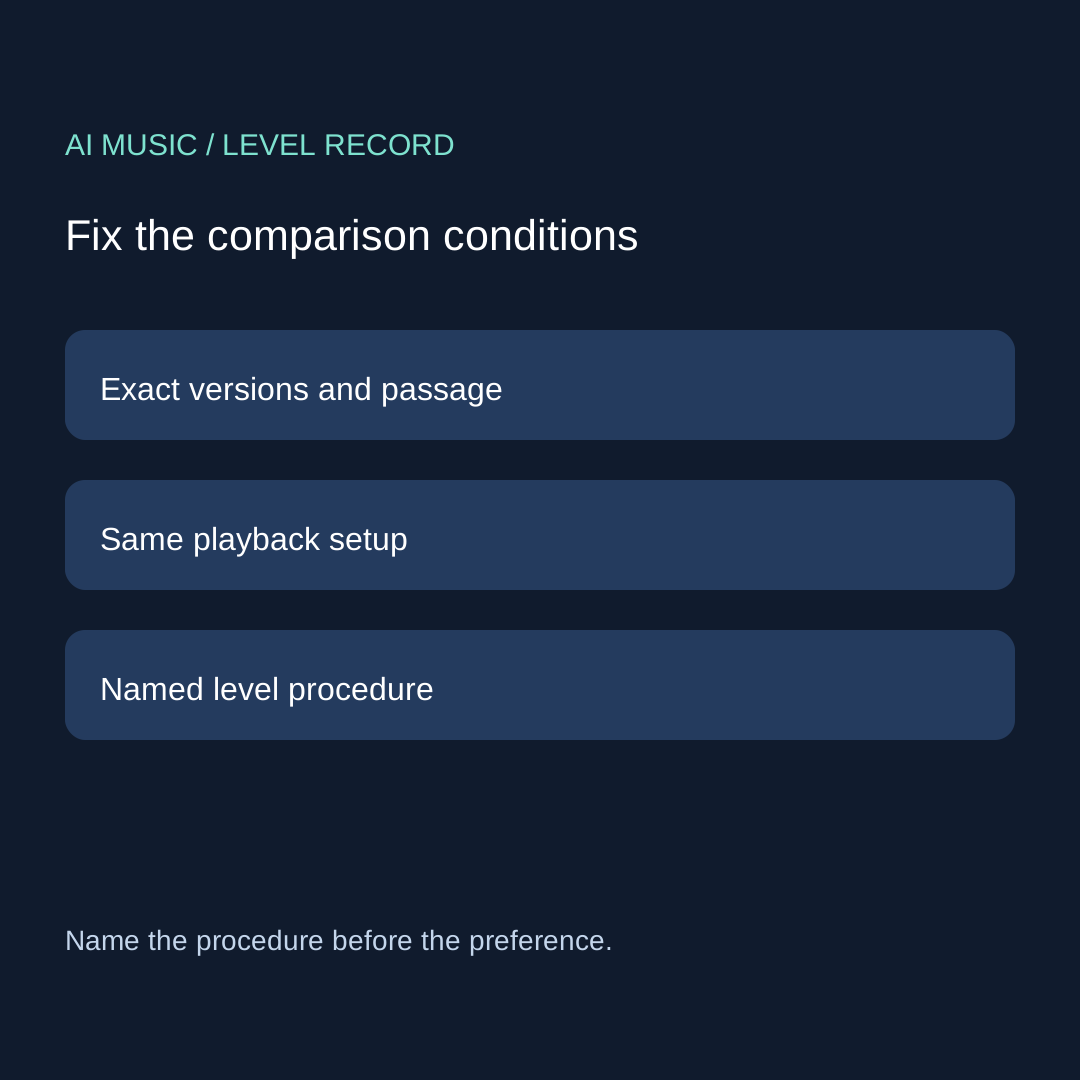
Keep four things explicit
| Condition | Record | Why keep it separate? |
|---|---|---|
| Source identity | Exact saved filenames and versions | A preview is not the same evidence as an identified saved file |
| Passage | Start/end positions and the event you judge | Different sections answer different questions |
| Playback setup | Player, device and settings used | An unexplained setup change clouds the comparison |
| Level procedure | Named measurement, scope and applied gain | Peak, RMS and perceived loudness are not interchangeable labels |
Preserve the originals. If you create adjusted copies, give them different filenames and write what processing you applied. Use the same selected passage in each version and name the musical feature you are comparing. If a vocal phrase is the task, a note about a different introduction does not settle that task.
An authored same-signal, different-gain exercise
We constructed a two-second mono signal at 24,000 samples per second, using signed 16-bit PCM. The reference samples are A[n] = int(4000 × sin(2π × 440 × n / 24000)), for n from zero to 47,999. The second file is B[n] = 2 × A[n]. It has the same sequence shape at twice the sample amplitude. These are controlled signals, not two generated songs.
A third file uses C[n] = int(0.5 × B[n]). Because every B sample was constructed as twice an integer A sample, the C array equals A exactly in this exercise. We verified that equality in the retained construction code. It is not a promise that arbitrary normalization, encoding or export processing will reproduce an original file exactly.
Reference A · Double-amplitude B · Adjusted copy C. The matching gain applied to B is 0.5. Expressed as an amplitude gain in decibels, 20 × log10(0.5) = approximately −6.0206 dB. Conversely, B's amplitude ratio to A is 20 × log10(2) = approximately +6.0206 dB. These calculations describe the authored sample scaling, not a measured preference or a universal loudness difference.
Name what the number measures
For each file we compute the largest absolute integer sample and RMS over all 48,000 samples. RMS = sqrt(sum(sample²) / N), with N = 48,000. The measurement record also reports 20 × log10(RMS / 32768), declaring the divisor used for that numeric dBFS convention. We do not label that value LUFS, perceived loudness or a product quality score.
| Authored file | Peak integer sample | Relationship to A |
|---|---|---|
| Reference A | 4000 | Reference sequence |
| Double-amplitude B | 8000 | Every sample is 2 × A |
| Adjusted C | 4000 | Every sample equals A after the stated gain |
The measurement CSV contains the computed peak, RMS, numeric dBFS, sample count and file hash. The construction record exposes the formulas and equality result. The reproduction script rebuilds all three WAVs and the CSV. Those are reproducible file properties; they are not a listening test.
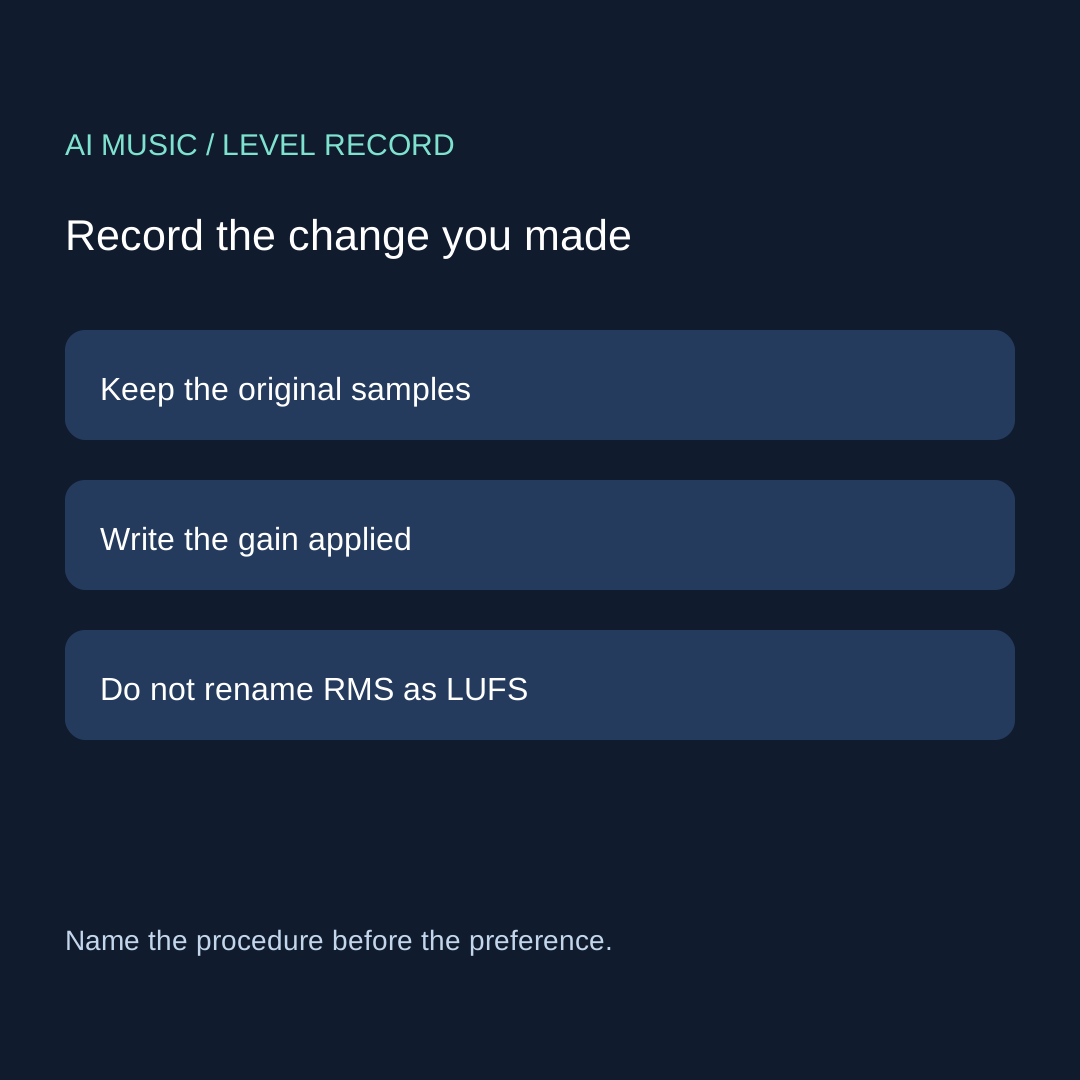
The original playback-level comparison card
DATE / TASK / REQUIRED MUSICAL EVENT:
ORIGINAL A / ORIGINAL B / VERSION IDS:
MATCHED PASSAGE START / END / UNITS:
PLAYBACK DEVICE / PLAYER / SETTINGS:
MEASUREMENT NAME / FORMULA OR TOOL:
MEASUREMENT SCOPE / CHANNEL TREATMENT:
VALUES BEFORE ADJUSTMENT:
GAIN OR OTHER PROCESSING APPLIED:
ADJUSTED COPY FILENAMES:
VALUES AFTER ADJUSTMENT:
LISTENING OBSERVATION / NOT CHECKED:
DECISION / REMAINING UNCERTAINTY:
Download the blank comparison card. A card with no adjustment can still be useful if it plainly records that condition. Do not claim a matched comparison without identifying the procedure and evidence. If your editor applies more than gain, list the extra processing before attributing a difference to the music itself.
Do not make a sample metric answer a perceptual question
In this exercise the adjusted sample sequence is identical to the reference by construction. Different musical mixes can share a peak or RMS value while containing different spectral, dynamic and temporal content. Equal values under one stated metric do not, by themselves, prove equal perceived loudness. If your task requires a perceptual listening comparison, keep the measurement procedure and the listener's observation as separate records.
For an authored hypothetical case, two candidates contain different vocal deliveries and have different measured levels. First retain the originals and document the comparison conditions. If you make adjusted copies using an authorized tool, record the procedure. Then describe a specific phrase or event in each take. This article supplies no observed preference between those hypothetical candidates.
Make one task decision
Choose a candidate when the evidence you actually gathered meets the brief. Otherwise, state one remaining uncertainty before another attempt. Use the version comparison guide for revision organization and the saved-file guide for export identity. A louder preview alone is not a complete record of a better result.
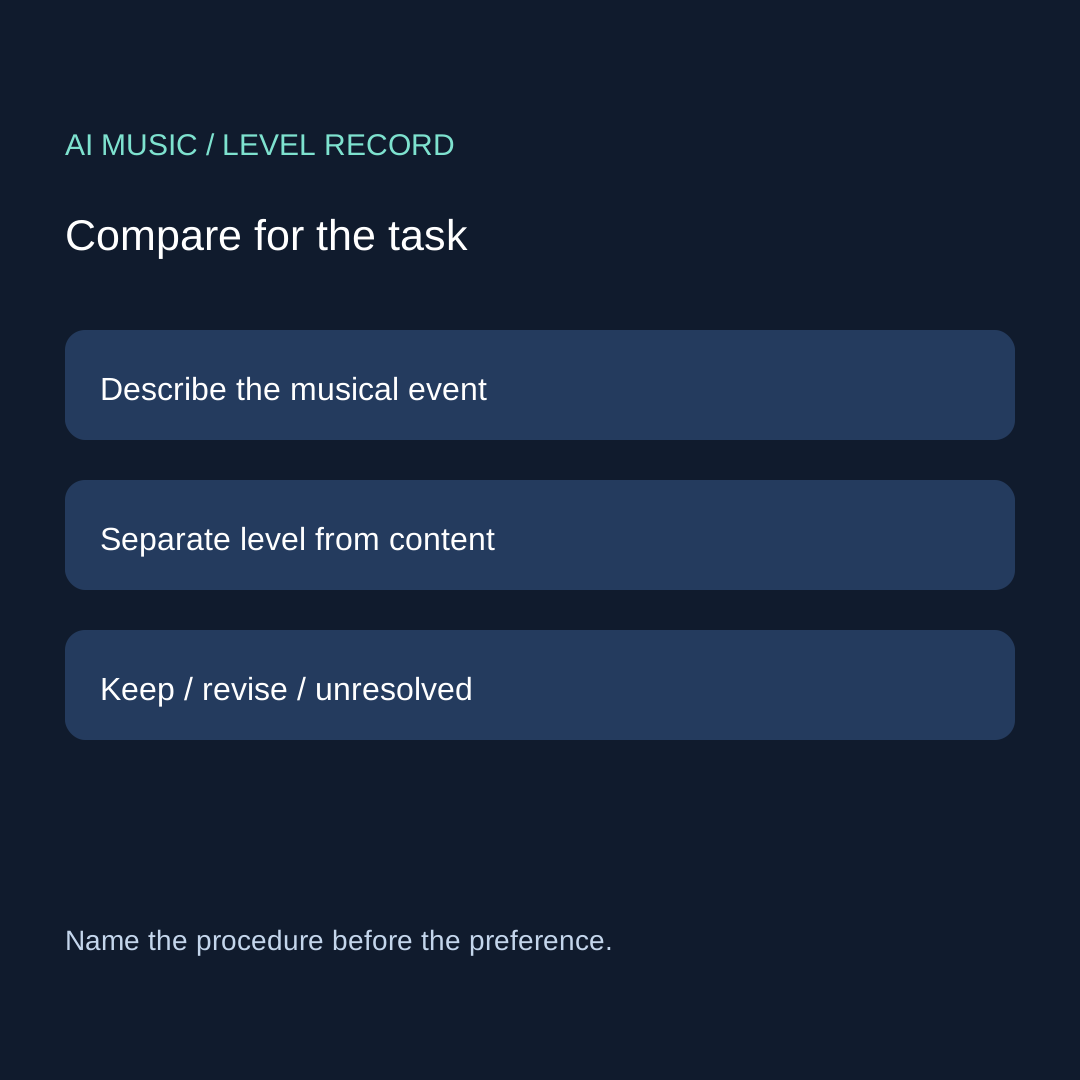
Four questions from the generator-selection task
Does a higher waveform peak prove a better take?
Not under this card. Peak is a named sample property, while your acceptance task may concern a lyric, phrase, arrangement or another event. Keep those judgments separate and record what you actually checked.
Is matching RMS the same as matching LUFS or perceived loudness?
No equivalence is claimed here. Our RMS formula operates on the declared sample array. If you use a different measurement or tool, name it and its scope rather than relabeling an RMS number.
Should I overwrite the original with a matched version?
This workflow preserves originals and creates named comparison copies. That lets you revisit the adjustment and distinguish a processing change from the saved source. It does not prescribe a release mastering target.
Can these exercises identify the top generator?
No. They expose a comparison condition using authored signals. A product claim needs its own authorized outputs, account conditions and traceable observations. Our method adds a record to your selection process; it does not invent a service winner.