Free AI Lyrics Generator: Five Original Briefs to Try Before Spending Credits

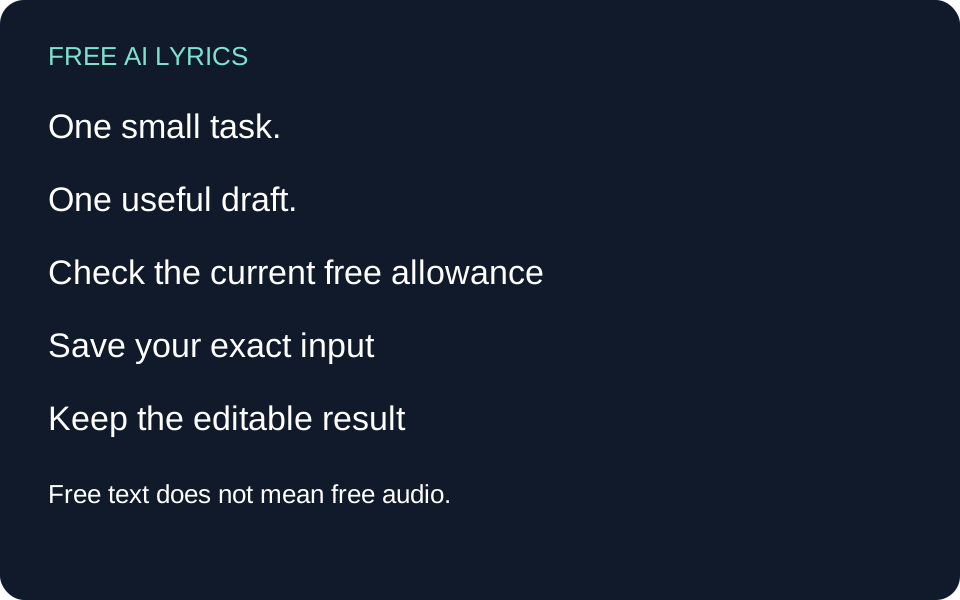
Start with one small writing task, save the result, and decide whether it helped before spending more credits. A free AI lyrics generator is useful when it gives you words you can edit and keep. Check the current sign-in requirements and free allowance in the tool itself. Free lyric text does not automatically include a sung track, audio downloads or unlimited revisions.
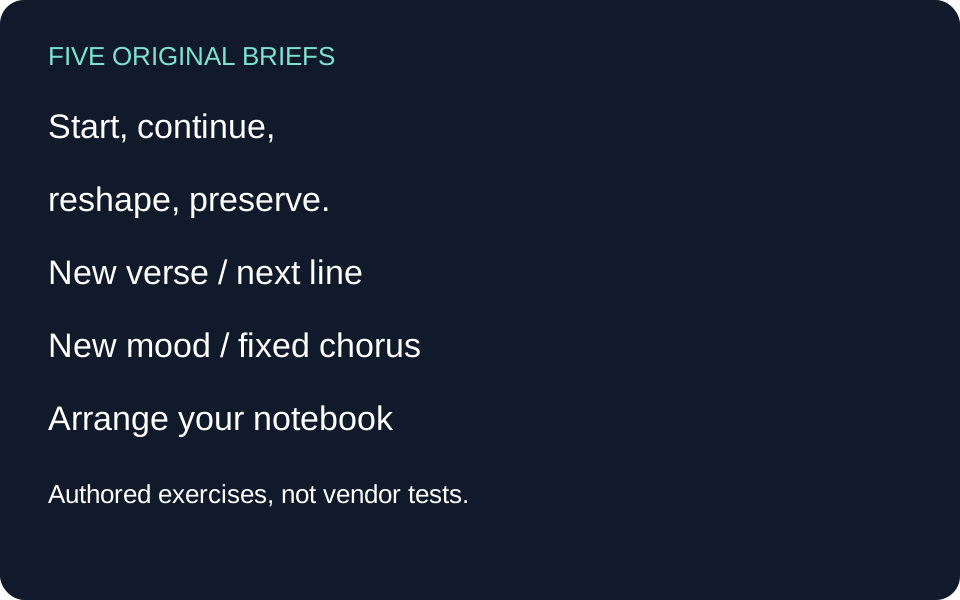
Published 29 October 2026. These five fictional writing exercises and sample directions were authored for AISongMakerLab. They are not vendor outputs or proof that a particular free plan completes them. This page provides prompts and a downloadable trial record; it does not run a generator or charge credits.
Start with the task you actually have
If your page is blank, request a short opening verse. If you already like most of a song, request alternatives to one line. If your words are ready, move to an own-lyrics song workflow instead of generating another lyric draft. Making that decision first gives you something concrete to judge after a free attempt.
For a current starting point, OpenMusic's public lyrics page presents a prompt field, mood and structure choices, and a free-start call to action alongside a login entry. That is what the public page shows, not a verified account allowance or a result from our test account. Open the lyrics workspace, inspect the current conditions, and use one of the briefs below if it fits your task. You can also use these briefs in another lyrics workspace that accepts your own instructions.
Keep a copy of your input before submitting. Afterward, save the actual response and label it with the tool and date. A sample displayed on a landing page does not establish that you can generate or copy a new draft under the same conditions. If the next step asks for payment, record that boundary instead of treating it as an included free feature.
Five original tasks for a useful first attempt
1. Start a verse from a specific scene
Your situation: You have an idea, but no opening line. The fictional scene is a caretaker opening an old community greenhouse after a storm. A cracked clay pot and a new green shoot matter more than a broad claim about hope.
Copyable brief: “Write a four-line opening verse in first person. I am opening our community greenhouse after a storm. Include a cracked clay pot and a new green shoot. Keep the language plain and the mood cautiously hopeful. Do not add a chorus yet.”
An authored direction to compare against:
I turn the key; the glass is cold
A cracked clay pot still keeps its hold
One green shoot leans toward the day
I brush the broken leaves away
What to look for: The result should begin the scene, keep the speaker consistent and include the requested objects. It need not resemble these lines. Next move: Choose one line you want to keep and request an alternative only for the line that feels least natural. If the answer supplies a whole song, record that it exceeded your requested scope rather than assuming more text is better value.
2. Continue your line instead of replacing the whole idea
Your situation: You already have a line that feels like yours. You want a continuation, not a new opening. Use this original line: “The last bus leaves a ribbon in the rain.” The scene is a traveler who has decided to walk home, not someone waiting for another bus.
Copyable brief: “Keep this line exactly: The last bus leaves a ribbon in the rain. Suggest two different next lines. In both, I choose to walk home. Do not change the first line or introduce another bus.”
Two authored directions:
I take the long way, counting lights again
My shoes find home before I name the street
What to look for: One option pursues an end rhyme; the other follows the scene without matching the rhyme. These are choices, not a ranking. Next move: Read the opening and each continuation aloud. Keep the one that leads toward your intended song. Save the unused line separately. Do not consume another attempt asking for a full rewrite when the decision you need is only between these two directions.
3. Change the emotion without changing what happened
Your situation: A fictional character is leaving a shared rehearsal room. You want the song to feel grateful instead of bitter, but the departure must remain a departure.
Original lines:
I leave the room; your chair stays bare
I pack the songs we could not share
Copyable brief: “Rewrite these two lines with gratitude rather than resentment. I am still leaving the rehearsal room today. Do not turn the ending into a reunion. Keep the chair and the songs as the concrete images.”
An authored alternative:
I leave the room; your chair stays there
I carry songs we learned to share
What to look for: The emotional framing changes while the action stays intact. A softer-sounding result can still miss the brief if it promises a return that you did not ask for. Next move: Mark the changed event or mood in your record before choosing a revision. If you only dislike one phrase, ask for alternatives to that phrase instead of repeating the entire generation. This example demonstrates a writing decision, not an emotional-accuracy score for a model.
4. Keep a chorus and write toward it
Your situation: You like your chorus and need a verse that earns it. The fictional song is about clearing a place at a table for a friend who is arriving late.
Original chorus to preserve:
Leave a little room for me
By the window, by the sea
Copyable brief: “Keep the chorus below unchanged. Write only a short verse that leads into it. A friend is arriving late for supper; I set another place at the table. Do not add a bridge, change the chorus or turn the story into a farewell.”
An authored verse direction:
The soup is warm, the clock is slow
I move a plate beneath the glow
Your coat will hang beside the door
We have enough for one friend more
What to look for: The verse should set up welcome, not merely reuse the chorus's rhyme words. Next move: Compare the preserved chorus with your saved copy, then read the transition. A repeated chorus can be convenient, but a newly rewritten chorus is a different result from the requested verse-only task. Record that difference before generating music.
5. Organize your rough lines without silently adding new lyrics
Your situation: Your notebook has several lines and no clear sections. Before you spend attempts on complete songs, you want to see a possible order and understand what is missing.
Original notebook:
A yellow cup beside the sink
There is more time than we think
The kettle clicks, the morning stays
We learn the shape of slower days
Copyable brief: “Use only these four lines. Propose an order and suggest which pair could serve as a verse and which as a short refrain. Show section labels separately from the words. Do not invent new lines. Explain one gap that would remain if this became a full song.”
An authored arrangement direction: use the cup and kettle lines to establish the scene, then use the time and slower-days lines as a recurring thought. That order is one possibility, not a generated result or a complete arrangement.
What to look for: You should be able to account for every original line. A polished answer that inserts new words has changed the task. Next move: Decide whether you want new material for the identified gap. If you do, make that a separate brief so you can distinguish organization from composition. If you do not, keep the short sketch; it does not need to become a full song just because a generator offers that button.
A reusable record for your free attempt
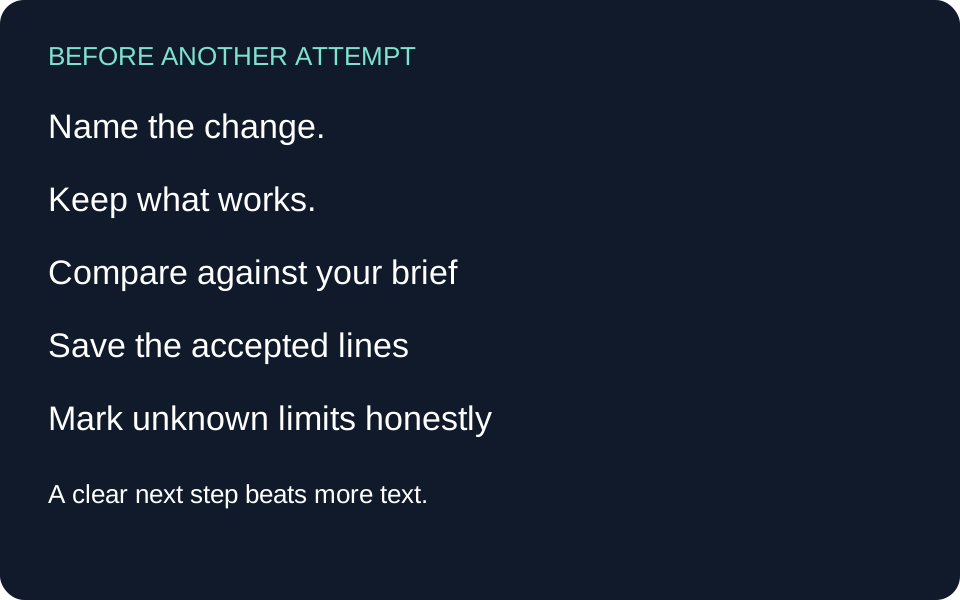
Save the task you chose, the exact input, the current allowance shown by the service, the response you actually received and whether you could keep the editable text. Write the one next change you want before using another attempt. If a limit or price is not shown, mark it unknown rather than guessing. Record a payment prompt as an observed boundary, not as evidence that every user has the same allowance.
Keep lyric writing separate from audio generation. Once the words are ready, save the accepted version and bring it to a supported own-lyrics mode. Listen for changed words in the resulting song. A text draft passing your brief does not establish that a sung performance will preserve it.
Questions before choosing a free lyrics workspace
Does free mean unlimited?
Do not assume it does. Check the current account conditions and what the next action costs. Our examples do not establish any provider's free quota, renewal schedule or paid pricing.
Do I need an account?
Read the actual input and submission flow. A public example or a visible prompt field can exist before a sign-in requirement appears. Record whether you could submit a new task, not just whether you could view the page.
Will a lyric generator also sing the words?
Only if the chosen workflow includes an audio-generation step. Editable lyrics and a finished vocal track are different outputs. Choose the writing stage first when you still need to revise your words.
What should I do with a draft I almost like?
Keep the accepted lines and ask for a narrow revision. Specify the line to change and the details to preserve. Compare the response with your saved text because a request to leave other lines unchanged is not a guarantee.
Which result should I keep?
Keep the draft that serves your scene and gives you a clear next step. Read it aloud, check the requested details and save the version you actually chose. More lines, more rhymes or a polished presentation do not by themselves establish that the task was completed.
Download five original exercises · Download the revision record