Choose Selectable Captions or Burned-in Lyric Text for Delivery

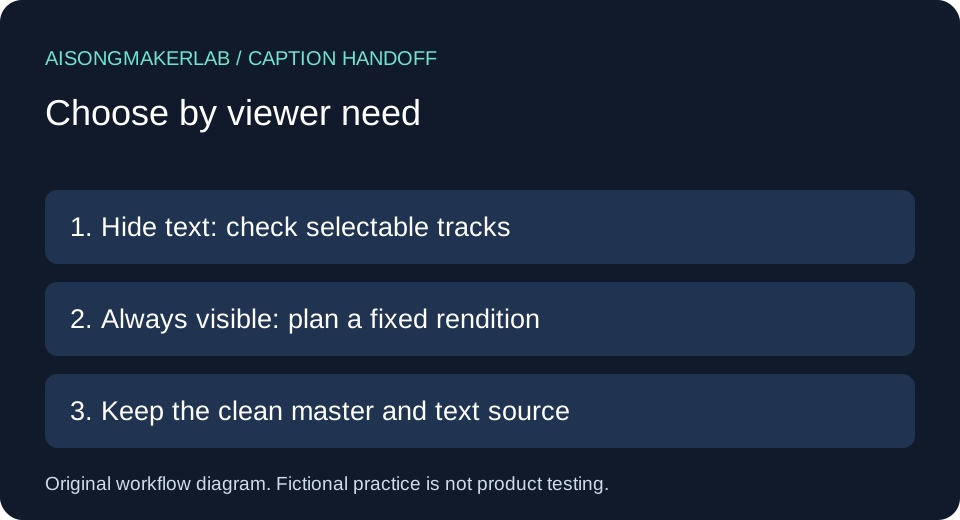
Choose a selectable caption track when viewers need to hide text, choose a language or adjust its appearance, and verify that the destination actually supports those controls. Burned-in text stays in the video image. Use it deliberately for a destination that needs permanently visible text, while keeping a clean master and editable caption source for other deliveries. Decide per destination, not once for every copy of the song.
Choosing the best AI music generator does not settle how your finished lyric video will deliver captions. This guide supplies a manual delivery decision and five self-authored fictional cases. No vendor output, player test, audience measurement or accessibility certification is claimed.
Start with a small handoff record
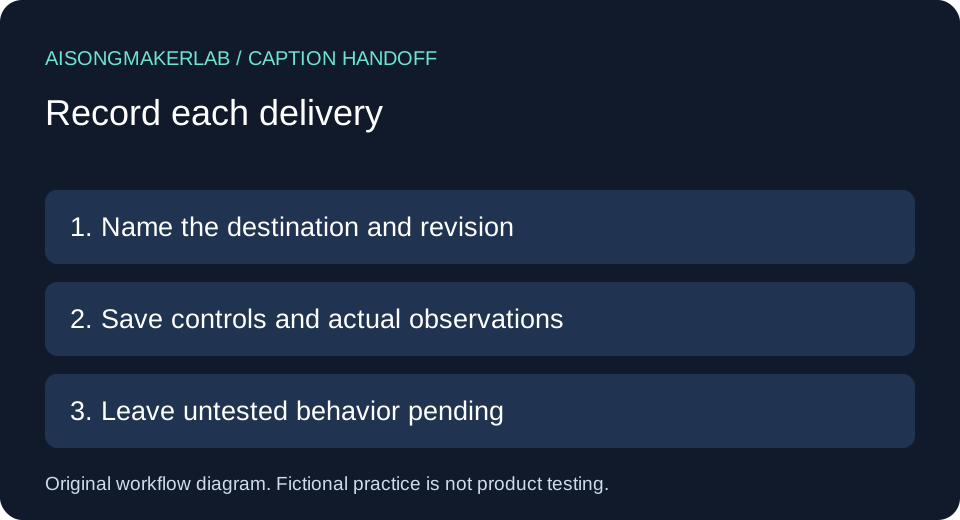
Write down the exact video revision, approved caption revision, destination and viewer need. Add separate fields for intended mode, observed controls and unresolved checks. A file accepted by an upload form is not evidence that viewers can select its track. Review the delivered player before marking a mode verified.
The W3C WAI caption guide distinguishes captions that viewers can hide from captions that remain displayed. Captions include meaningful audio information as well as speech. A decorative lyric overlay may therefore be incomplete as captions. The WAI media-player guide describes controls and notes that some players offer caption appearance settings. These sources explain the distinctions; they do not establish what your destination supports. Sources read November 9, 2026.
A practical comparison sequence
- Name the viewer task: read always-visible words, hide text, change appearance or choose a language.
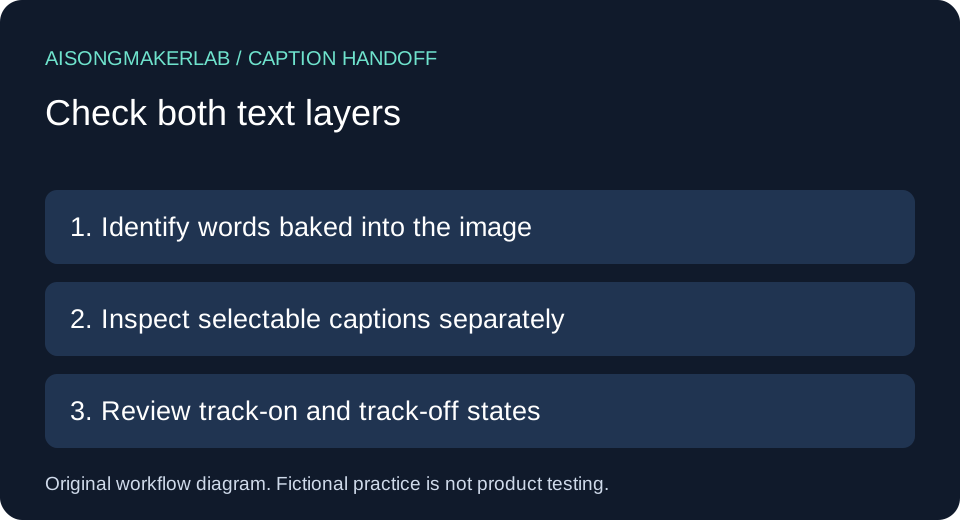
- Separate artwork baked into the image from timed text supplied to the player.
- Keep a clean video master, editable caption source and clearly named delivery copies.
- Inspect each intended track and control in the actual destination; write down what happened.
- Resolve duplicate overlays and missing meaningful audio information before approving that delivery.
Five self-authored fictional cases
Every person, project, requirement and decision below is an invented teaching example authored for this article. Expected checks are proposals, not observations. No video was generated or player tested for these cases.
1. A viewer needs to switch the words off
Fictional brief: Mira is preparing a performance called Lantern Steps. One delivery is intended for viewers who want the sung words visible; another viewing preference is an unobstructed scene. The editor has only a copy with large lyric lettering baked into each shot and proposes adding a selectable caption file beside it.
Authored decision: Keep the burned-in copy as a clearly named separate rendition. For the viewing experience that must support hiding all lyric text, return to the clean master and attach the approved timed text. Adding a selectable track does not make existing image lettering switchable. Record which master each delivery uses so the wrong copy is not selected later.
Review record: Destination and player remain unspecified; support is pending. The proposed acceptance action is to show the text, hide it, and check that the intended lyric overlay disappears while playback continues. If words remain because they are part of the picture, record the exact persistent layer. Do not label this delivery switchable merely because a caption button exists. The unresolved item belongs to the delivery, not to Mira's lyric wording.
2. The intended destination has no selectable track
Fictional brief: A lobby display is specified to play a single video file with no viewer caption controls. The fictional song includes a sung refrain and a meaningful door knock. The editor has a clean video plus a separate timed-text file, but the delivery brief allows only the video file.
Authored decision: Prepare a dedicated always-visible text rendition for that requirement. Preserve the editable source and clean master for future destinations. Include the meaningful knock in the caption plan rather than treating decorative refrain lettering as a complete representation of the audio. Do not reuse this fixed-display decision automatically for a web player with different capabilities.
Review record: The no-track condition is an invented requirement, not a measured device limitation. Before actual use, the proposed reviewer should confirm the display's real configuration and play the complete delivered file. Record whether every intended caption is present and readable, and whether any picture information is hidden. If the real destination supports a preferable selectable mode, revise the plan. A transcript can be an additional resource, but this worksheet does not treat it as an automatic replacement for synchronized captions.
3. Burned-in lyrics and another caption track collide
Fictional brief: The Harbor Window project has artistic words in the lower frame. A second editor adds a caption track containing the same sung lines plus a speaker label. The team expects the second track to provide useful information, but has not checked how both layers appear together.
Authored decision: List the two text layers separately. The clean-master version with complete selectable captions is the first candidate for the destination that permits it. If artistic lettering must stay, review both track-on and track-off states and redesign the composition where needed. Do not delete necessary caption content solely to conceal a collision in one layout.
Review record: Use fields for baked-in words, selectable words, duplicate passages and proposed remedy. A short invented refrain, Stay beside the window, can be entered in both layer fields to expose the duplication during planning. The proposed playback check follows the entire refrain, not one still frame. Until the destination has been viewed, mark overlap unknown. A second track is not automatically harmful, and two visible text layers are not automatically usable; the record must describe the particular delivery.
4. A viewer needs a different text appearance
Fictional brief: Sol's study group wants to increase caption size while viewing a lyric video. The editor likes a small fixed font and assumes that a separate caption file guarantees a size control everywhere. No destination has been chosen and no control has been inspected.
Authored decision: Make adjustable appearance an explicit destination requirement. Keep the clean video and editable text ready, but leave the delivery choice pending until the player offers and preserves the needed controls. Burned-in lettering cannot be independently resized by a caption-style setting because it is already part of the image. Enlarging the entire video is a different action and may change what remains visible.
Review record: Name the player, device, control used, requested size and observed result. If controls exist, the proposed reviewer should check several passages after changing the setting and after seeking elsewhere in the video. Record clipping or hidden content for correction. If the control is absent, write absent rather than guessing a keyboard shortcut. This fictional requirement does not imply that every selectable-caption player offers the same customization.
5. Language choices need understandable labels
Fictional brief: A team preparing the invented song Paper Ferry has an original English caption track and a separately reviewed Spanish translation. The files are called final-one and final-two. The team wants viewers to choose between them without confusing the language of the recording with the language of the displayed text.
Authored decision: Map each file to a clear language label and content purpose in the handoff record. Keep revision identifiers alongside the labels so a later correction can be traced. Check translation approval separately from file selection. Merely renaming a track does not verify its language, meaning, completeness or timing.
Review record: Enter the approved file, intended displayed label, audio language and whether meaningful sound information is included. The proposed destination check selects each track in turn and compares the displayed content with its approved source. Also inspect the no-track state and any default selection. All these observations are pending in this example. Avoid burning both full language versions into one picture just to avoid configuring labels; that would create a different layout problem without providing genuine viewer selection.
Keep the comparison reviewable
Use one row per destination and mode. Record requirements before export, then add actual observations afterward. Save the filename and revision, not only a link whose content may change. Separate a verified delivery from a prepared file and from an untested alternative. Reopen the review whenever the master, captions or destination changes.
Frequently asked questions
Are burned-in lyrics always complete captions?
No. Check whether they carry all meaningful audio information needed to understand the piece, including relevant sound cues and speaker distinctions. Presentation mode alone does not establish completeness.
Can a caption button hide text inside the video image?
No. It controls the track presented by the player, not lettering already rendered into the image. Retain a clean master when you need a delivery without that lettering.
Does a separate file guarantee style controls?
No. Inspect the actual destination. Record which settings are available and what happens when they change. Leave untested combinations pending.
Can the same song have different delivery versions?
Yes. Keep the master and approved caption source together, name each rendition by destination and mode, and verify each delivered version independently.
What should I keep after delivery?
Keep the clean master, editable captions, exact delivery files, language mapping and observation record. These let another editor correct one delivery without reconstructing the approved text from the picture.
Download the five fictional cases · Download a blank review CSV