Prepare Lyrics for a Lyric Video: Break Lines Without Changing the Words

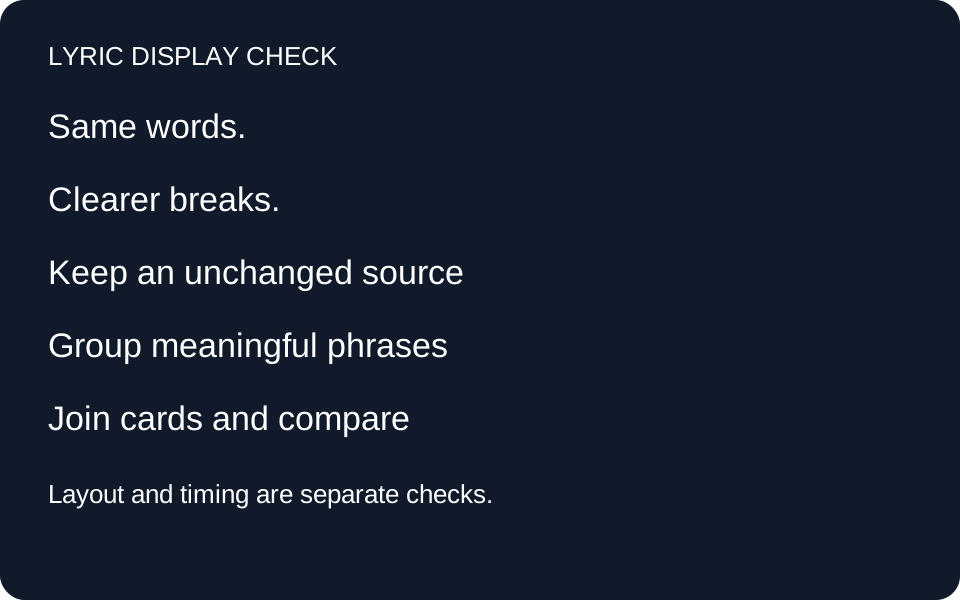
Keep the approved words in their original order, then add display breaks at phrase boundaries. Keep a negation with its verb and a name together when space allows. If a card feels crowded, try another card before deleting words. Finally, join the cards back together and compare them with the source. This checks text preservation; it does not prove timing, pronunciation, or readability in a rendered video.
Choosing the best ai music generator does not finish the lyric-display job. A song draft, a lyric sheet, and text placed over a video are separate artifacts. This guide gives you a manual way to prepare the third without accidentally rewriting the first. You need an approved text copy, a place to record cards, and the actual video layout for a later visual check.
Start with one unchanged source
Save a revision label before making breaks. Work on a display copy. Treat a line break within a card differently from a card change: the first rearranges visible text, while the second may hide words until later. Do not insert slashes into the final captions merely because this worksheet uses them as separators. The examples below use a vertical bar to show a proposed line break and a double bar to show a proposed card change. Those symbols are annotations, not lyric words.
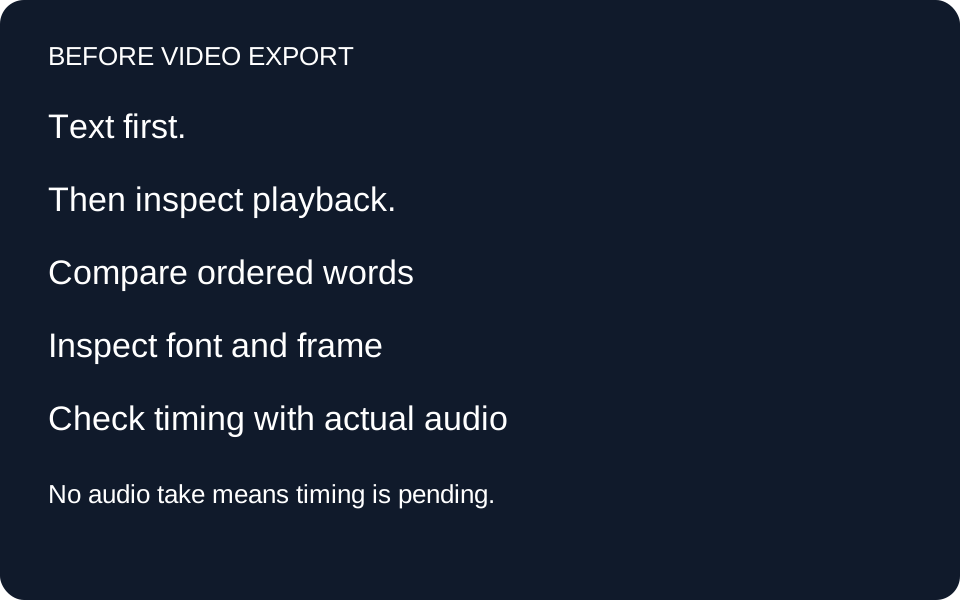
There is no universal character limit in this exercise. Font size, actual available width, margins, and the chosen frame change what fits. A line that fits on a desktop preview can still be too small on a phone. Keep phrase grouping and visual fit as two separate checks; neither replaces watching the finished sequence with the audio.
Five original fictional caption exercises
These are self-authored fictional exercises, not vendor outputs, real customer stories, or generated song tests. All words and proposed layouts below were written for this guide. No corresponding sung performance or synchronized caption export was tested.
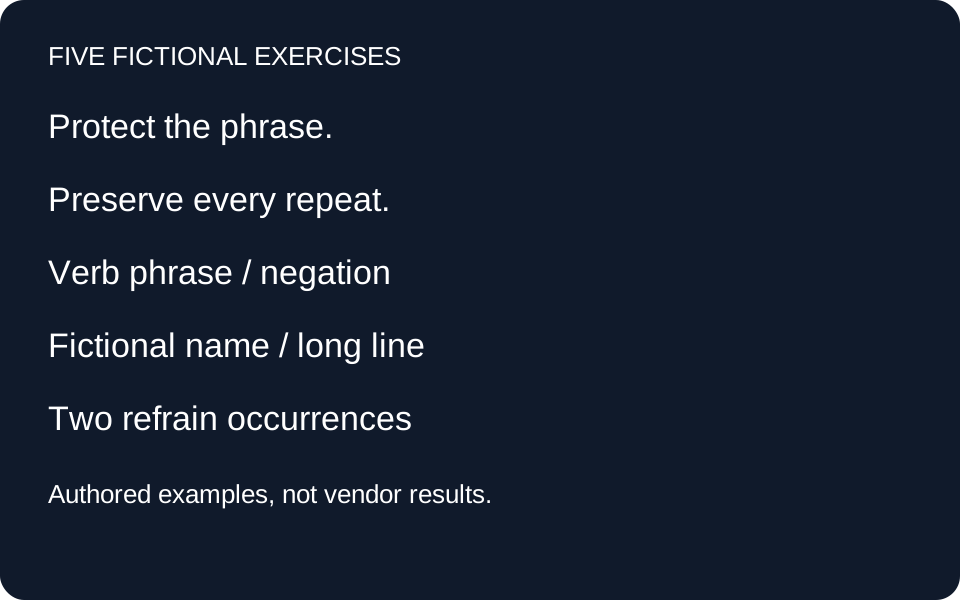
1. Keep a short verb phrase together
Source: “We carry the lantern home before the rain.” A mechanically balanced split might produce “We carry the | lantern home before the rain.” It retains the words, but the article hangs at the end of the first line and the object arrives on the next. Our proposed display is “We carry the lantern home | before the rain.” The first line carries the central action; the second supplies its condition. Neither version is a measured comprehension result. This is an editorial choice you can inspect.
For a narrow frame, try “We carry the lantern | home before the rain.” If that still requires tiny text, move a whole phrase to the next card and review the change against the sung delivery. Do not shorten the source to “We bring it home” just to fit. That would change both wording and reference. Record the source revision, the exact displayed words, and the chosen break. Acceptance for this exercise means joining the displayed lines returns the source wording in order. Whether the singer leaves room for a card change remains unobserved.
2. Keep a negation with its verb
Source: “I will not leave you waiting at the gate.” A risky card plan is “I will || not leave you waiting at the gate.” The first card temporarily presents an unfinished thought, while the second carries the negation and action. Our proposed two-line card is “I will not leave you | waiting at the gate.” This keeps the promise together without replacing any word. It is a suggested grouping, not proof that every viewer reads the first plan incorrectly.
If the whole card is too crowded, try “I will not leave you || waiting at the gate” and inspect the transition with the actual take. Keep “not” visible with “leave”; never remove it as a supposed filler word. A useful review question is whether a viewer pausing at each card sees an unintended assertion. The text comparison should detect deletion of “not,” but it cannot decide whether the display duration allows comfortable reading. Mark duration as pending until an actual playback check exists. A successful word comparison is only the first acceptance condition.
3. Keep a fictional name readable
Source: “Mara Vale keeps a light beside the river.” Mara Vale is an invented name for this exercise. A split such as “Mara | Vale keeps a light beside the river” separates its two parts. Our first candidate is “Mara Vale keeps a light | beside the river.” If the first line is too long at the chosen font size, try “Mara Vale | keeps a light beside the river.” Both retain the full name, but place the emphasis differently.
Do not replace the name with initials or a pronoun unless the lyric owner approves an actual revision. A display adjustment should not silently become a rewrite. Put the name on a small protected-text checklist and compare spelling, case, and order after copying into the editor. If the renderer wraps the name anyway, change the layout or card grouping and inspect it again. A plain text file cannot guarantee a font renderer will honor your preferred grouping. Record the inspected frame size separately from the proposed text. The exercise ends with unchanged words and a proposed layout, not with a claim about synthesized pronunciation.
4. Break a long line without deleting its ending
Source: “When the last train leaves the station we will walk beside the water.” A tempting shortcut is to discard “beside the water” because the sentence already sounds complete. That deletes an image from the approved lyric. Our proposed card sequence is “When the last train leaves the station || we will walk beside the water.” The first card contains the condition; the second completes the action and keeps the ending. If both fit together, a two-line card may be preferable to a card change.
Write the complete source above the proposed cards before adjusting the layout. After editing, concatenate the cards with spaces and compare the ordered words, including the ending. A word-count match alone is insufficient: replacing “water” with “platform” keeps the count but changes the lyric. Our downloadable check therefore compares the sequence, including punctuation attached to words. It ignores only whitespace. A clean result still cannot establish where the second card should appear in a recording. Do not invent timestamps from the length of the written sentence. Add timing observations only when an actual audio take is available.
5. Preserve every repeated refrain
Source: “Hold the light. Hold the light. We are coming home.” A display copy can accidentally collapse the repeated sentence into one occurrence, especially when someone assumes it is a duplicate. Our proposed sequence is “Hold the light. || Hold the light. || We are coming home.” The first two cards intentionally contain identical words; they represent separate occurrences. Label them occurrence one and occurrence two in the worksheet, outside the displayed lyric text.
Do not put “repeat twice” on screen as a substitute for the repeated words. That is an instruction, not the lyric. Keep both occurrences in the ordered text comparison even when the editor reuses a single visual template. If the actual performance repeats the refrain a different number of times, record the disagreement and decide which artifact needs revision; do not silently force the approved sheet to match an unreviewed take. This fictional case contains two repetitions by construction. It does not establish the arrangement of any generated song. Check the final card sequence visually as well, because an editor could contain the correct words while showing one card only once.
A reusable display record
Record the source revision, unchanged source text, proposed lines and cards, protected phrases, and the result of the ordered-text comparison. Add separate fields for layout inspected, audio take, timing observations, and unresolved decisions. Leave the last three pending when there is no video or audio to inspect. The downloadable examples contain actual line and card breaks; the comparison joins their whitespace and checks against the source. Deliberate negative controls demonstrate that removing a negation or a repeated line fails the check.
Questions before export
Does changing line breaks change the lyrics?
Changing whitespace can preserve the ordered words. Removing, replacing, or reordering words does not. Our check keeps punctuation and spelling significant, so punctuation edits require review too.
Should every caption have the same number of characters?
No fixed count is prescribed here. Start with meaningful phrases, then inspect the actual font and frame. Equal counts alone do not establish a readable layout.
Can I get timestamps from this worksheet?
No. It contains proposed text grouping, not measured audio timing. Use the actual take and record what you observe before marking synchronization checked.
Can repeated lyrics use one card?
An editor may reuse a visual design, but preserve each occurrence in the sequence and check that playback shows it at the intended time. The worksheet keeps both occurrences explicit.
What should I do when the words do not fit?
Try a different phrase boundary or another card, then review the visual result. If you decide to rewrite, create a new lyric revision and obtain the appropriate approval before using it as the source.
Five fictional cases and executed checks · Blank display record · Readable Python word checker
Research lead: OpenMusic music video page, read 1 November 2026. Its page separates video formats, showcases and FAQs; it inspired this display-preparation task, not the examples or a tested capability claim. No vendor caption export was tested.