Free AI Music Generator: Check Left and Right Before Replacing a Mix
Keep the original file and compare identified left and right events before replacing a mix. Two channels do not prove preserved order. Separate a swap from duplication, polarity and level changes.
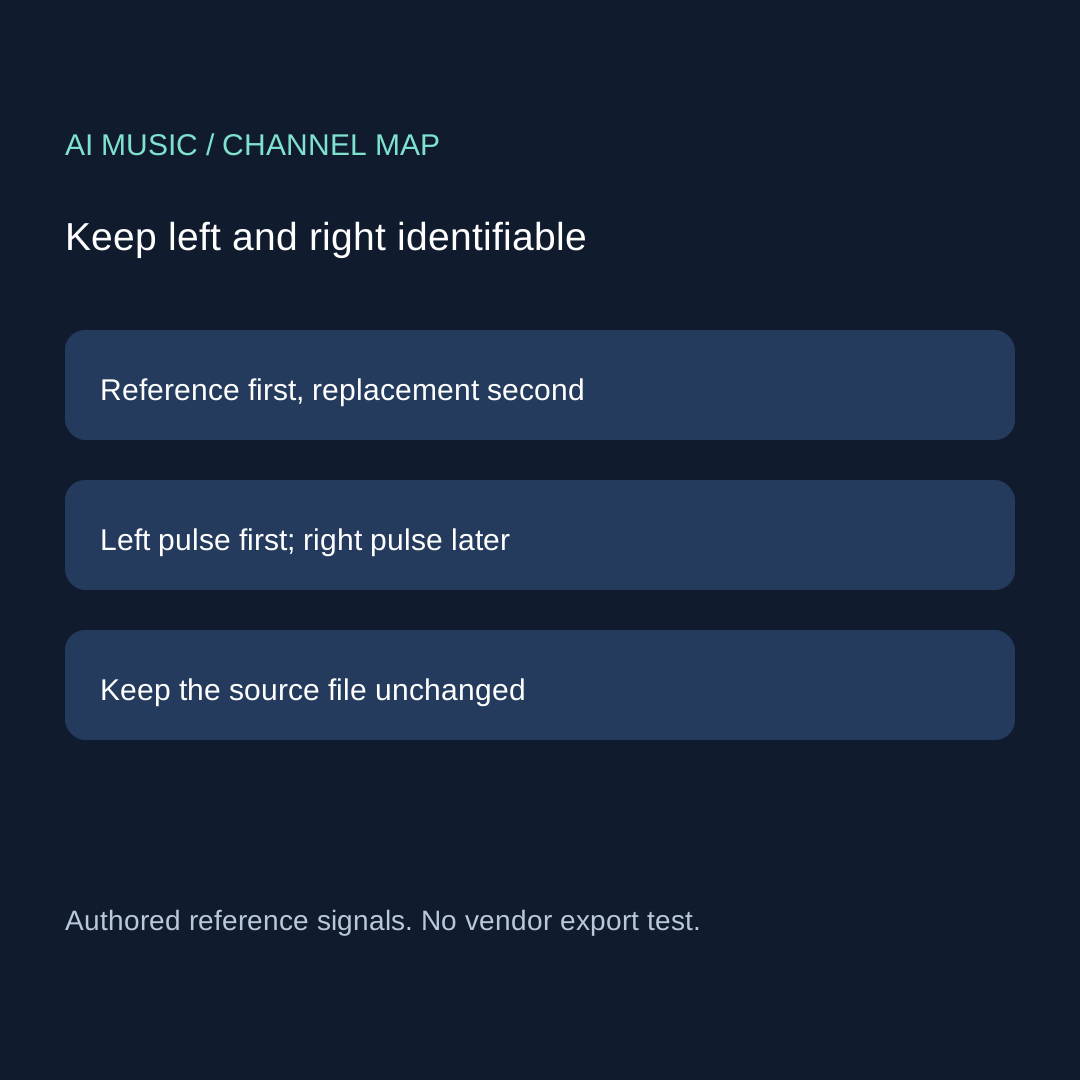
Check the file channels before you replace the take
In a free AI music generator workflow, a playable stereo preview is only the beginning of a channel check. Keep the exact original download, identify the intended left and right events, and compare the proposed replacement before deleting anything. Two stored channels do not prove that their content stayed on the same side. Our material archive includes a generator-selection question as a topic lead; it is not a verified quotation or a report of a channel fault in any product. This page supplies an original file exercise for a decision that feature lists leave to you.
Use a known reference before investigating an unfamiliar mix. A centered vocal does not identify channel order: it can sound similar after swapping. Pick a clearly identified left event and a separate right event in the source, or use the labelled exercise below to learn the comparison. Do not claim that our reference represents your generated song. Nothing here uploads music, signs into a generator or checks a vendor's free plan.
Five files made for this check
We wrote a two-second, stereo, 16-bit PCM reference at 44,100 samples per second. Its left channel contains a 440 Hz tone from 0.2 to 0.7 seconds; its right channel contains an 880 Hz tone from 1.0 to 1.5 seconds. Other samples are zero. The peak target is 8,191 integer sample units, and each file contains 88,200 stereo frames. These are deliberately simple, self-authored signals, not songs, service downloads or measured generator output. Start with low playback volume; the useful evidence is the declared file-channel sequence and comparison record.
Four transformations create the other cases. Swapped exchanges the complete left and right arrays. Left duplicated copies the left array into both channels. Right inverted changes the sign of every right-channel integer. Right half truncates each right-channel integer divided by two toward zero. We reopened every written WAV and compared the decoded sample arrays. All five still have two channels and the same duration. This is why channel count and duration alone cannot distinguish them.
| Authored case | L matches source L | R matches source R | Swap pair |
|---|---|---|---|
| reference | True | True | False |
| swapped | False | False | True |
| left-duplicated | True | False | False |
| right-inverted | True | False | False |
| right-half | True | False | False |
reference: download the two-second authored WAV
swapped: download the two-second authored WAV
left-duplicated: download the two-second authored WAV
right-inverted: download the two-second authored WAV
right-half: download the two-second authored WAV
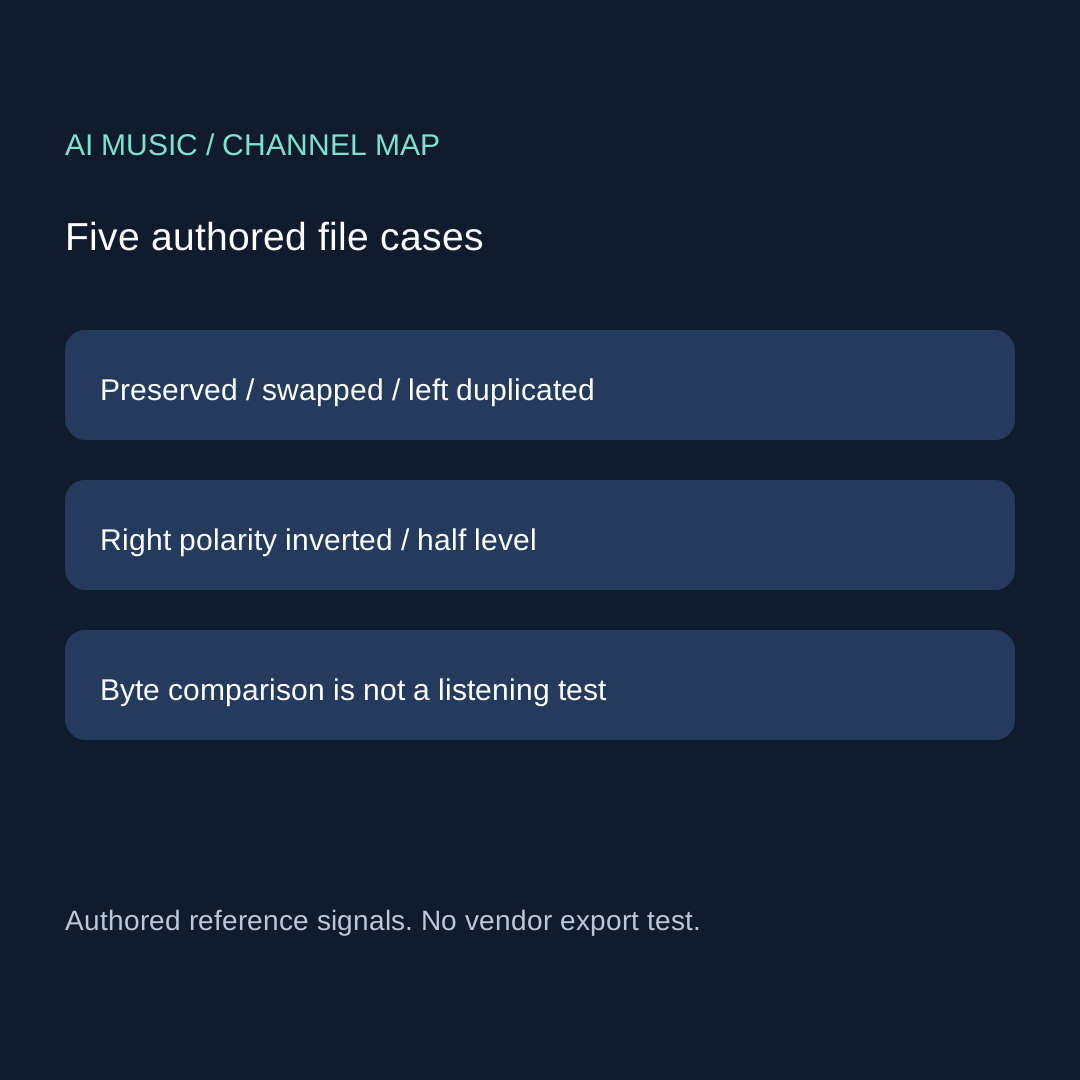
Read the result without merging different faults
The preserved reference matches both original channels. The swapped case matches neither original side in place, but matches the opposite-side pair exactly. The remaining three preserve the original left channel and change the right. That shared true/false pattern is insufficient to tell duplication, polarity inversion and gain change apart. The retained result JSON includes the additional exact comparisons that distinguish these constructed cases. A single pass/fail label would hide the important difference.
Right polarity inversion is not a channel swap. The right event remains in its original time window, although its sample signs change. Likewise, reducing a channel's sample values does not move the event to the other side. A byte-for-byte result only applies to these controlled files. A real edit, codec conversion, gain change, sample-rate conversion or time offset can break an exact match without swapping the channels. Do not report a failed equality check as proof of a routing problem in an arbitrary music file.
Keep an evidence card beside the actual replacement
Record the source file name, version and hash before testing. Name the expected file-channel order and the events that establish it. Keep the proposed replacement as a separate file and write the comparison method explicitly: decoded samples, a timed channel event, or a documented listening observation. A claim about file contents is different from a claim about a room's speakers. Headphone orientation, output routing, mono playback and spatial processing belong in the playback record, not in an unexplained conclusion about the download.
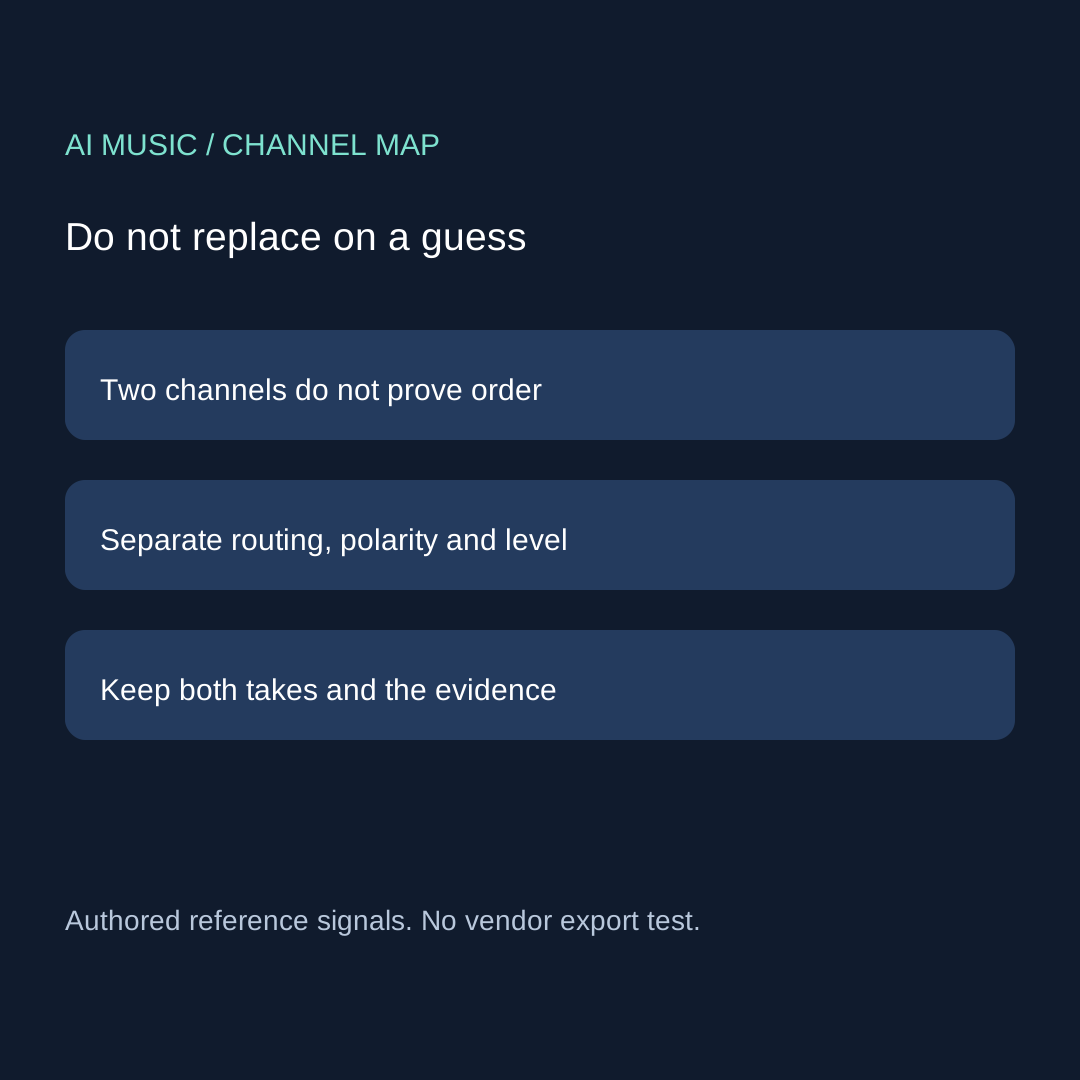
If the intended left event appears on the right, preserve both files and investigate the routing step. If both channels contain the same identified event, investigate duplication separately. If the file order is intact but a channel is quieter, record the level observation rather than calling it swapped. If the evidence cannot identify the cause, stop before replacing the source and write the next check. You do not need another generation attempt merely to conceal an uncertain comparison.
SOURCE FILE / VERSION / SHA256:
EXPECTED FILE CHANNEL ORDER:
REFERENCE FIRST EVENT / SECOND EVENT:
BEFORE AND AFTER FILES (KEEP BOTH):
LEFT AND RIGHT COMPARISON METHOD:
EXACT MATCH / SWAP / DUPLICATION / POLARITY / GAIN:
PLAYBACK DEVICE / MONO OR SPATIAL PROCESSING:
WHAT THIS DOES NOT PROVE:
NEXT CHECK BEFORE REPLACING:
Download the blank record · Readable exercise source · Retained exact results
Reproduce the exercise in a new folder
The readable Python source uses only the standard library. Save it in a new exercise folder and run it there. It writes five named WAVs and a results JSON beside itself, replacing files with those names in that folder. It does not inspect your music library. The five comparisons assert the expected in-place matches, the swapped pair and the two explicit right-channel transformations. Keep the source and results together so someone else can distinguish the construction from a claim about a product.
For a generated track, retain the actual downloaded version and state what you observed. Do not extrapolate from these tones to musical quality, free export availability, stereo width, rights or suitability for release. For a mono decision, use the separate fold-down record; for an edit boundary, use the partial-edit preservation card. This page answers the narrower replacement question: which file-channel information changed, and what evidence supports that statement?
Four questions from the selection workflow
Does a two-channel WAV prove left and right were preserved?
No. Every constructed file here has two channels, including swapped and duplicated cases. Check the identified contents.
Does right-channel polarity inversion mean the channels were swapped?
No. It changes sample signs on the same side. The separate timing and opposite-channel comparisons keep these claims apart.
Can an exact sample mismatch diagnose any downloaded song?
No. Unrelated processing can also change samples. State the transformation assumptions and compare identifiable events before naming a cause.
Should I delete the original after one good preview?
Keep it until the replacement has been checked with an identified file and method. This worksheet does not establish that a preview and a download are the same version.
Related checks: mono fold-down · partial-edit preservation · download verification.