Best Free AI Music Generator for a Stereo Track: Keep a Mono Check Record

Compare the same saved passage in stereo and under a named mono conversion. Keep file identity, conversion settings and listening observations together. Choose against your intended use; a stereo preview or an unexplained difference is not enough evidence for a verdict.
Watch the mono check
Three records · Controlled exercises · Mono card · Decision rule
Choose a workflow you can actually check
For a stereo-track task, the best free AI music generator is a workflow whose saved result you can inspect against your intended use. This page does not award a vendor winner or verify a free plan. Its original mono card adds one acceptance question: what happens to the same saved passage when you apply a named mono conversion?
A free-generator selection question in our material archive supplies the topic lead. The contribution is a repeatable comparison card, controlled signal files and an explicit fold-down calculation. We did not generate music in a service or test any account's export rights. Check the actual account conditions separately; a stereo preview is not evidence that a free saved file is available.
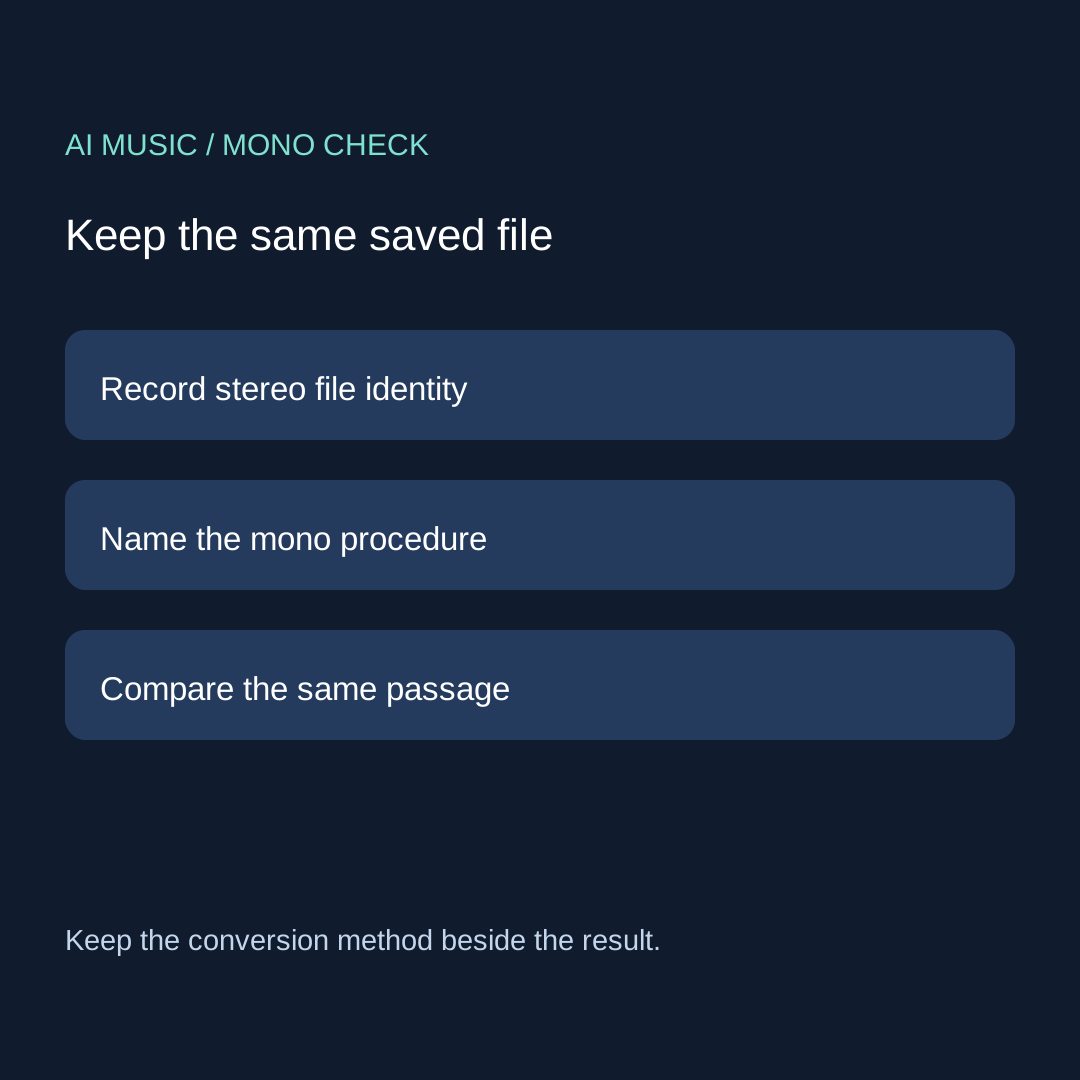
Three records before another generation attempt
| Record | What to write | What it does not establish |
|---|---|---|
| Saved-file identity | Filename, version and the passage you will compare | That a preview and saved result are identical |
| Conversion procedure | Named setting or exact channel formula | That every device uses the same conversion |
| Acceptance brief | Which musical elements must remain usable | A universal score for stereo width or quality |
Keep the source file unchanged and save a separate mono copy if your authorized editor supports it. Compare the same time window, starting with your written brief. If a vocal, bass part or texture seems different, name the event and its position. A vague verdict such as bad in mono does not tell you what to inspect or which revision might help.
Two constructed stereo cases, with the formula exposed
We authored a 440 Hz sine using x[n] = int(8000 × sin(2π × 440 × n / 24000)). Each file contains 48,000 frames at 24,000 frames per second: 48,000 / 24,000 = 2 seconds. The WAV samples are signed 16-bit PCM. These are mathematical exercises, not generated songs, vendor exports or recorded listening-test outcomes.
Case A uses matching channels: L[n] = x[n] and R[n] = x[n]. Case B uses opposite sample polarity: L[n] = x[n] and R[n] = −x[n]. For both, our mono procedure is M[n] = int((L[n] + R[n]) / 2), rounding toward zero. That average is the procedure for this exercise; it is not a claim about every player's mono button.
| Constructed case | Calculation | Result of this procedure |
|---|---|---|
| A: matching channels | (x + x) / 2 = x | Mono samples equal the original x sequence |
| B: opposite channels | (x + (−x)) / 2 = 0 | Every mono sample is zero |
Case A stereo · Case A averaged mono · Case B stereo · Case B averaged mono. The final file is intentionally digital silence. Whether you hear a difference in a particular playback setup is a separate observation; your device may already combine channels. Do not treat a browser playback result as proof of its channel-routing configuration.
The construction record preserves the formula, frame count, channel count, peak integer sample, nonzero-sample count and file hash for each asset. These are properties calculated from our authored arrays. They are not loudness readings, quality ratings, audibility thresholds or statistics about an AI service.
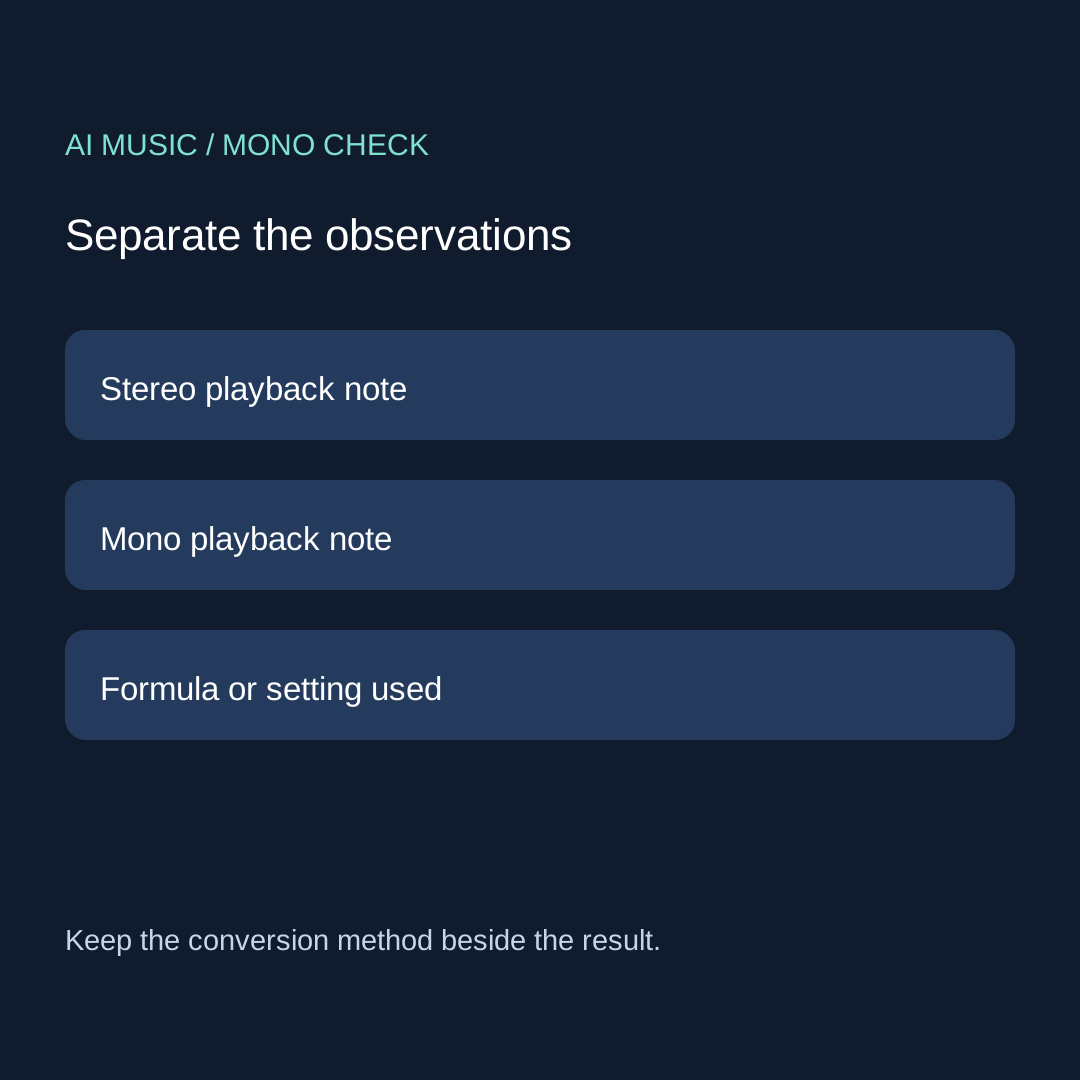
The original mono evidence card
DATE / WORKFLOW / ORIGINAL FILE:
VERSION / EXACT PASSAGE:
INTENDED USE / ELEMENTS TO PRESERVE:
STEREO PLAYBACK SETUP / OBSERVATION:
MONO SETTING OR EXACT FORMULA:
MONO COPY / PROCESSING APPLIED:
SAME PASSAGE / MONO OBSERVATION:
CHANGED ELEMENT / TIME POSITION:
WHAT WAS MEASURED / NOT CHECKED:
ONE SUPPORTED REVISION TO INVESTIGATE:
DECISION: keep / revise / stop unresolved
Download the blank mono card. Use it with a file you are authorized to process. Keep the original stereo and the derived copy distinct. If the conversion also normalizes, compresses or changes another setting, record that processing rather than attributing every difference to channel averaging.
Separate the mechanism from the musical decision
Our opposite-channel example cancels completely under the stated average because each pair sums to zero. A musical mix may have many different relationships between its channels. The exercise does not prove that a real song has the same construction, and it does not justify a blanket claim that wide music fails in mono.
In an authored hypothetical case, a background layer becomes less noticeable after your named conversion while the main vocal remains acceptable. Record the layer, the passage and whether your brief requires it to remain. You might accept that result for one use and reject it for another. The card makes that decision explicit rather than turning an unexplained listening preference into a product verdict.
Name one remaining task before spending another attempt
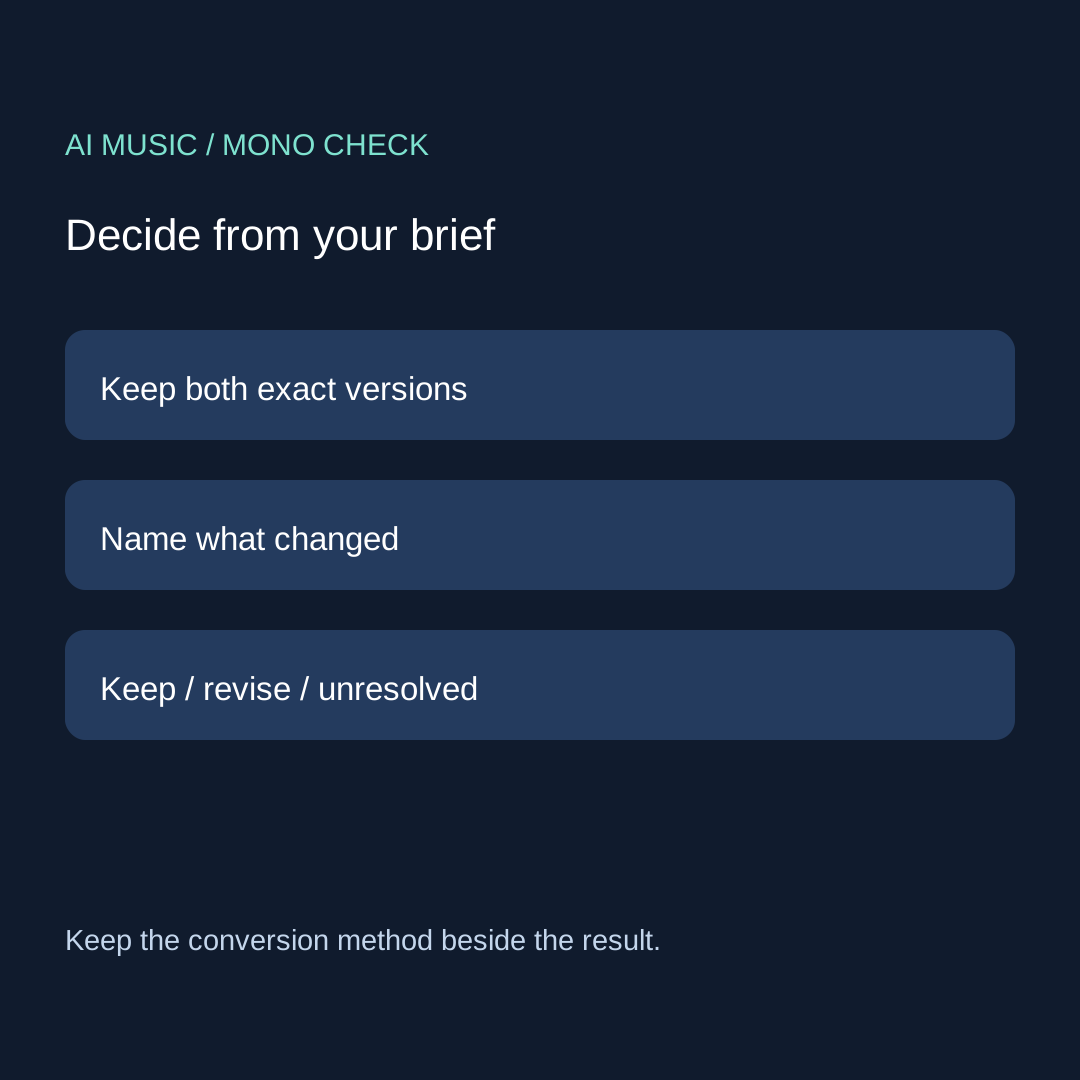
Keep a candidate when the observed mono result meets your brief and you can identify the saved file and procedure. Otherwise, preserve both versions and name the remaining mismatch. Investigate one supported action only when you can state what the next comparison should establish. Stop unresolved when you cannot separate routing, conversion or source-file uncertainty.
Use the saved-file evidence guide for download questions and the partial-edit preservation card if an attempted repair should leave other sections untouched. A new full generation is not the first answer to a missing filename or an unknown conversion setting.
Four questions from the free-generator selection task
Does a free stereo preview prove I can export that stereo file?
No export entitlement was tested here. Read the current conditions shown by your workflow and verify the actual saved file separately. Our downloadable exercises do not establish any service's free-plan features.
Is a mono button always the average of left and right?
This article specifies that average only for its own exercise. For your workflow, record the documented or displayed setting. If the behavior is unknown, keep it unknown rather than importing our formula as a fact about that player.
Does a difference in mono mean I should reject the track?
Compare the observed change with your intended use. The mathematical example explains one mechanism; it supplies no universal acceptance threshold. Retain a specific listening note and your decision, not just a score.
Can a clean loop prove the mono version is usable?
No. The loop seam card checks a return across a selected boundary. This mono card checks a named channel conversion. Keep those observations separate so a pass on one task does not stand in for evidence on the other.