Best AI Music Maker for a Clean Loop: A Seam Evidence Card
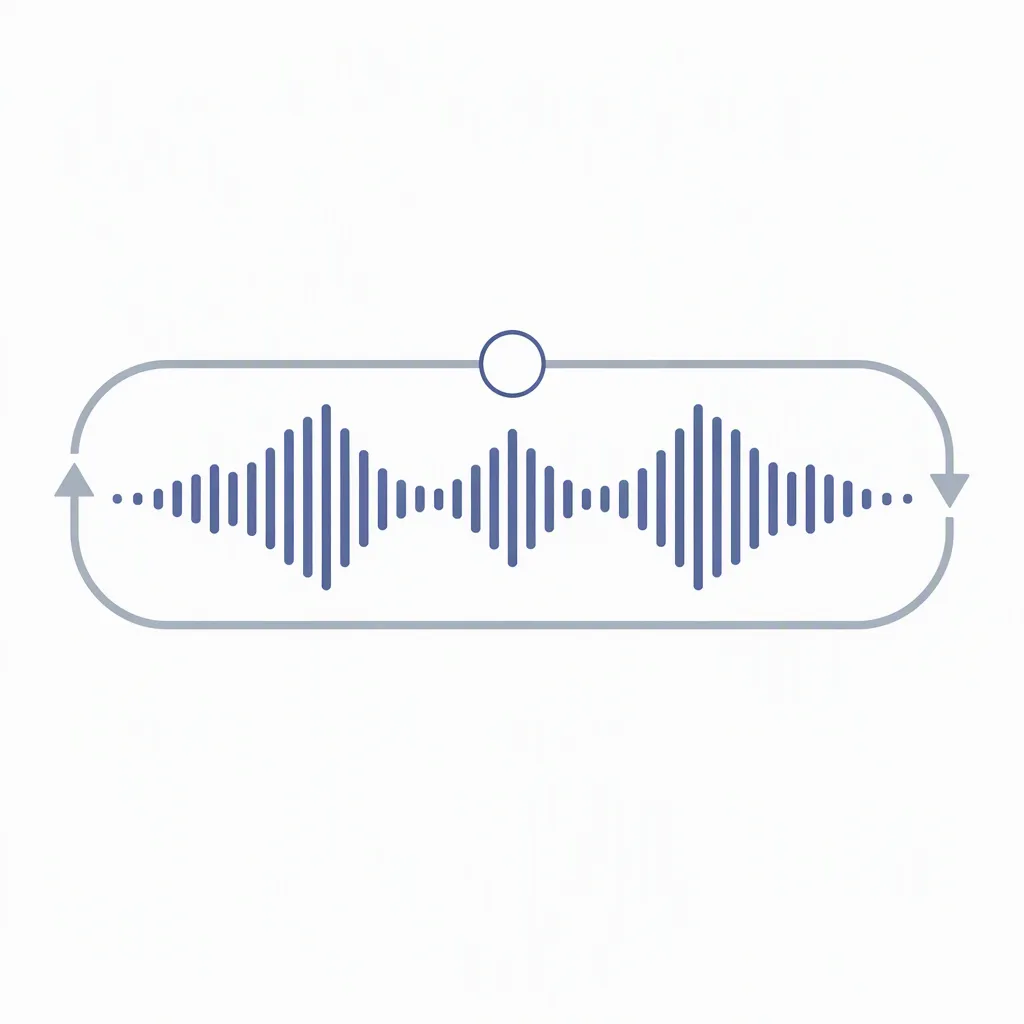
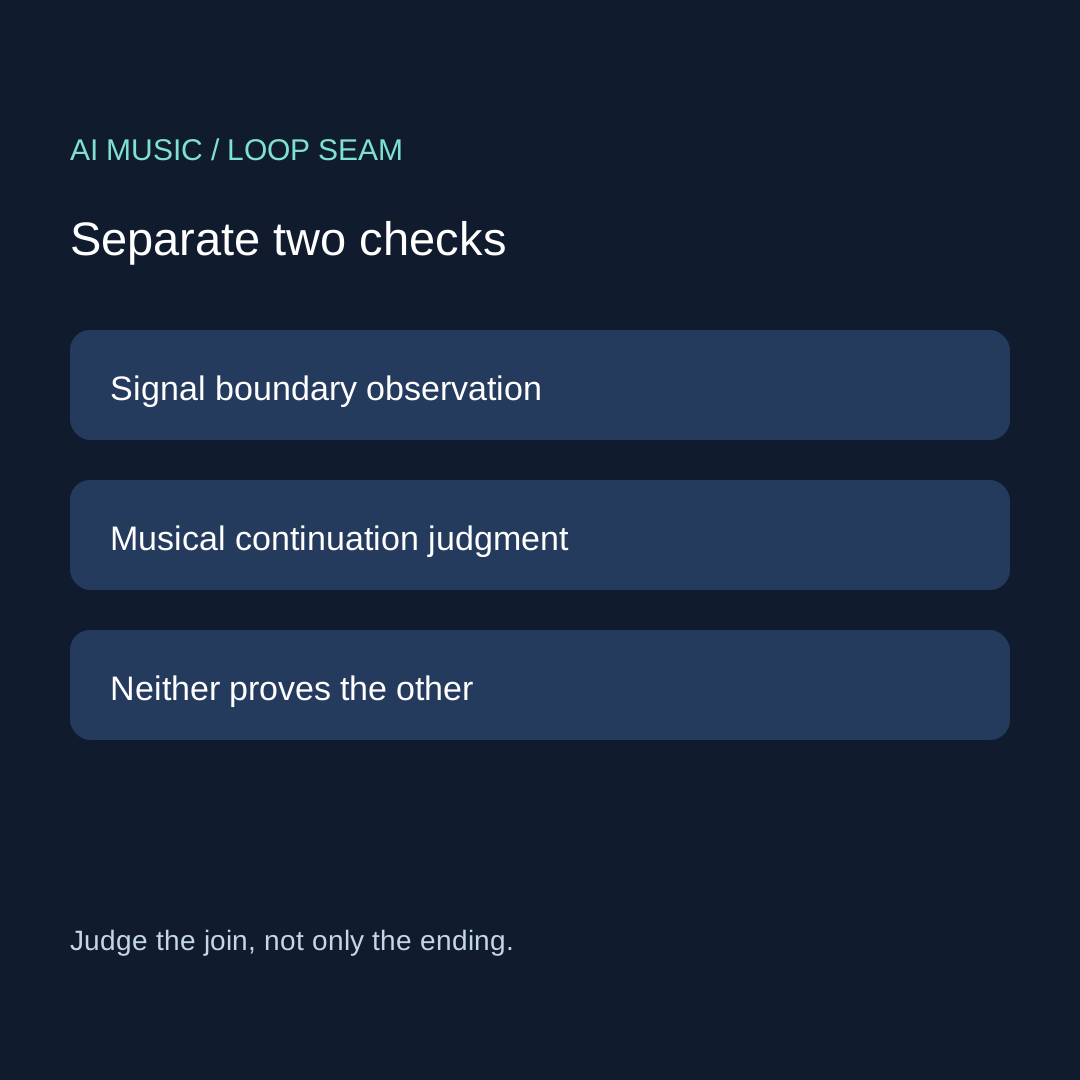
Judge the return from end to start. Record the loop points, listen across the join, and separate signal observations from musical judgment. Save the original, compare one change, and keep the selection only when it meets your brief.
Separate the checks · Seam card · Practice audio · Decision rule
Define a loop task before selecting a maker
For this task, the best AI music maker is a workflow that lets you inspect and revise the return from the end of your selection to its beginning. Our original seam card starts with that return. A pleasant standalone ending is a different requirement: a loop asks what happens when the next repetition begins.
A generator-selection question in our material archive supplies the topic lead. We are not quoting an independently verified interview or publishing a new vendor ranking. The new contribution is a repeatable seam record, two constructed audio exercises and a rule for comparing one revision. No service has been tested for this article, and no account cost or export feature is assumed.
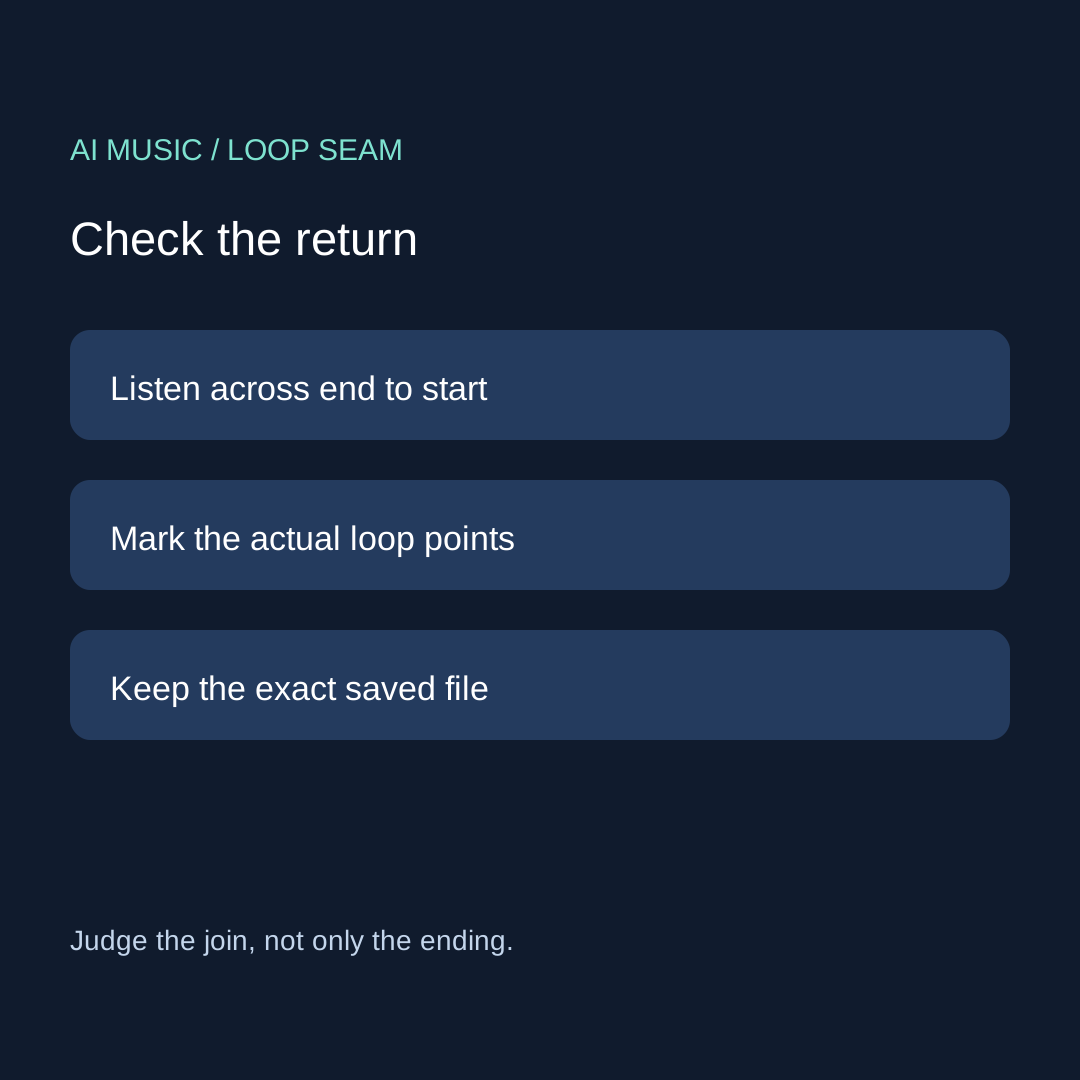
Two checks that should stay separate
| Check | Record | What it does not prove |
|---|---|---|
| Signal boundary | Selection points and any inspected sample or waveform difference | That the phrase or rhythm feels continuous |
| Musical return | Your listening note across the join, including the event that changes | That the file boundary has been measured |
| Saved-file replay | Exact filename and whether the same selection repeats there | That a preview and export are identical without comparison |
Our rule is to avoid using one observation as a substitute for another. If you notice a level jump, name that mismatch. If the next repetition starts on an awkward phrase, describe the phrase. A boundary number belongs beside a signal observation; your musical acceptance decision belongs beside the written brief. Keep both when available and mark either unresolved when it has not been checked.
The original seam evidence card
- Write the intended use. Specify whether you need a repeating bed, a short cue or a practice loop. Describe the return you want before judging the file.
- Name the exact selection. Record start and end positions using the editor's displayed units. Do not assume the whole exported track is the loop.
- Replay across the join. Include the end and the next beginning in the same observation. Keep a time reference or a repeat number so you can find the event again.
- Separate the mismatch. Write a signal observation, a musical judgment, or both. Avoid the unhelpful label “bad loop” without a specific event.
- Save before changing. Retain the original file and selection. Try one supported action, then compare the same join window.
DATE / WORKFLOW:
INTENDED USE / ACCEPTABLE RETURN:
ORIGINAL FILE / VERSION:
LOOP START / END / UNITS:
REPLAY WINDOW OR REPEAT NUMBER:
SIGNAL OBSERVATION OR NOT CHECKED:
MUSICAL RETURN NOTE OR NOT CHECKED:
ONE CHANGE / CONDITION SHOWN:
REVISED FILE / SELECTION:
SAVED FILE REPLAYED: yes / no
DECISION: keep / one revision / stop unresolved
Download the blank seam card. This is an evidence worksheet, not a product score. If an editor or generator does not expose an operation you need, record the missing capability rather than treating its control label as a successful result.
Watch the loop check
An authored boundary exercise, with the numbers exposed
We constructed a 440 Hz sine at 24,000 samples per second with an amplitude of 12,000 in signed 16-bit PCM units. Exercise A repeats a selection of 48,000 frames three times. Exercise B repeats a shortened selection of 47,800 frames three times. They use the same signal formula but different cut positions. Neither is an AI-generated song or a vendor test.
Exercise A: whole-cycle selection · Exercise B: shortened selection. The selection durations follow frames / sample rate: 48,000 / 24,000 = 2 seconds; 47,800 / 24,000 = 1.9916667 seconds, rounded to seven decimals. Each download contains three repetitions so you can inspect two internal joins without configuring a player loop.
Open the files in an editor and inspect the last sample before a join and the first sample after it. Our retained construction script records those sample values and their absolute difference. This difference is a boundary observation, not a loudness measurement or an audibility threshold. We do not tell you what you must hear on your equipment.
The exercise deliberately has no lyrics, drum pattern or changing musical phrase. It can illustrate an inspected cut boundary; it cannot prove that a generated musical return is satisfying. Write that limit on the card. When using your actual track, add your own phrase and rhythm observations instead of copying the exercise's result.
Two authored decisions
Case A: the return changes the phrase unexpectedly
In this hypothetical case, a phrase seems to restart before your intended idea is complete. Record the actual selection and the event you mean. Investigate whether a supported selection change or revision addresses it. Keep the original. Do not call a tail fade a successful loop repair merely because the end sounds quieter.
Case B: the preview loops, but the saved selection is uncertain
This hypothetical workflow shows a repeat in its preview, yet you have not confirmed the export's selection points. Your next task is version and file evidence. Replay the saved result, record its identity and compare the join. Use the download evidence checklist for the file investigation; do not regenerate a song to solve a missing filename.
Make one seam decision
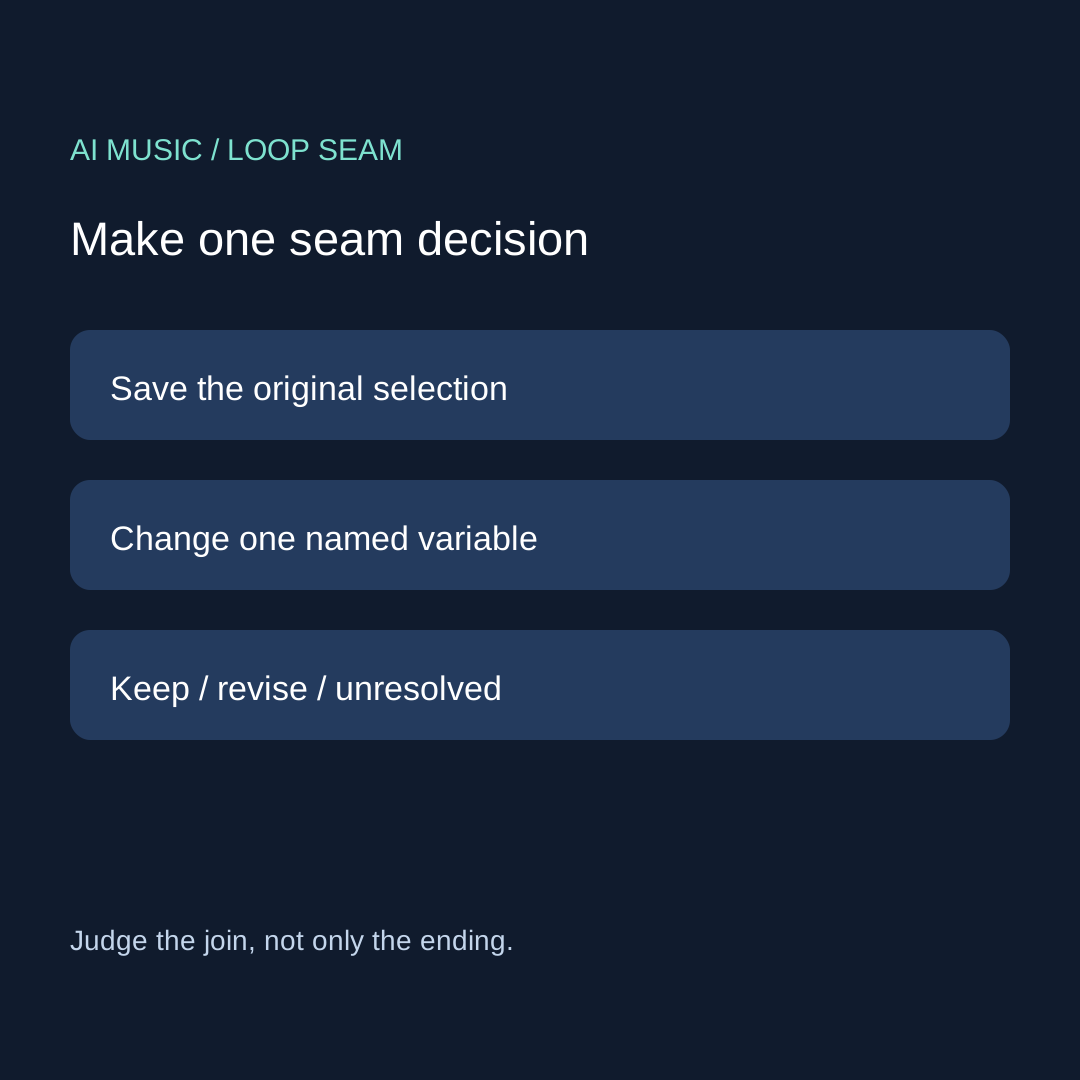
Keep a selection when its observed return meets your written brief and you have replayed the saved file. Otherwise, name one remaining mismatch. Continue only when a supported action is available and its displayed condition is acceptable. If not, keep the original and record stop unresolved. This method does not promise a seamless result after one edit.
Four questions from the generator-selection task
Does a clean ending prove a clean loop?
Not in this checklist. A standalone finish and a return to the beginning have different acceptance conditions. Use the ending evidence card for a finished song, and this seam card for repetition.
Should I always add a crossfade?
This method does not prescribe one edit for every mismatch. Read the actual workflow's help, preserve the original and compare whether the supported operation addresses your recorded problem without damaging the phrase.
Can one boundary number choose the best maker?
No product verdict is supplied here. A number from a constructed signal is not a musical evaluation of a service. Use the card to define the observation you still need from your own authorized output.
What if I cannot tell whether the return improved?
Record inconclusive, keep both versions and replay the same window. Resolve unfamiliar interface language with the control-to-task glossary. Do not spend another attempt without naming what that attempt should establish.