AI Music Generator Free: Plan a 30-Second Cue Before Generating
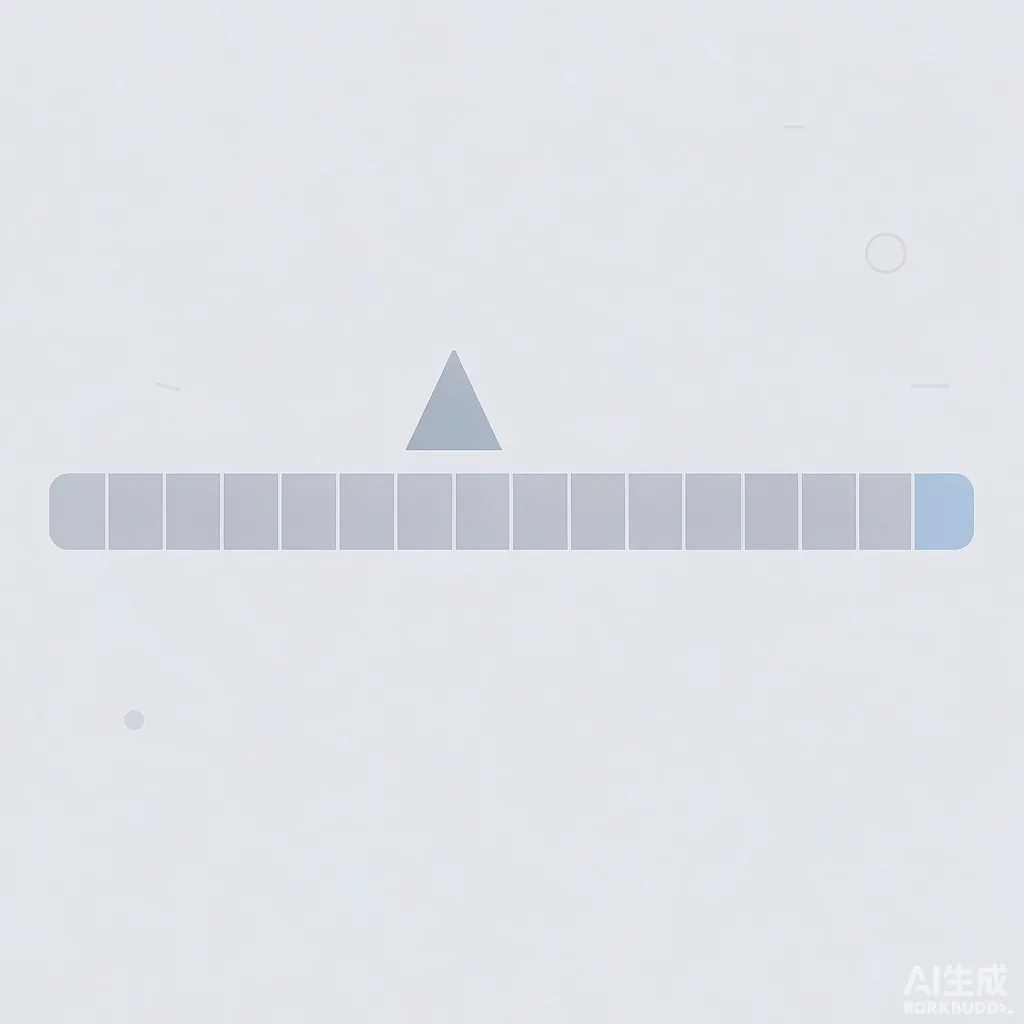
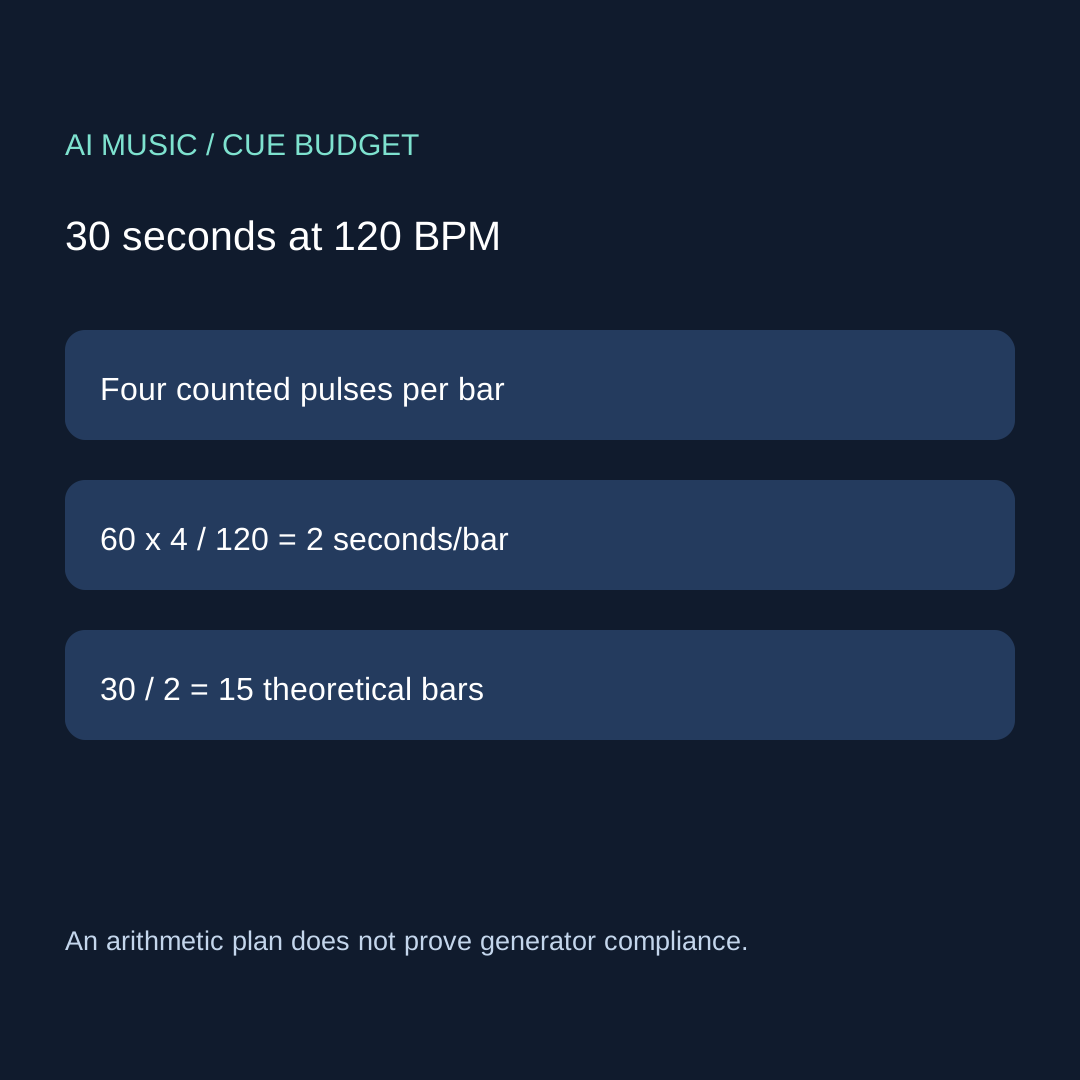
At a constant 120 BPM with four counted pulses per bar, 30 seconds allows 15 theoretical bars. State the pulse unit and any reserve first. A calculated budget does not prove that a generator will produce the requested length.
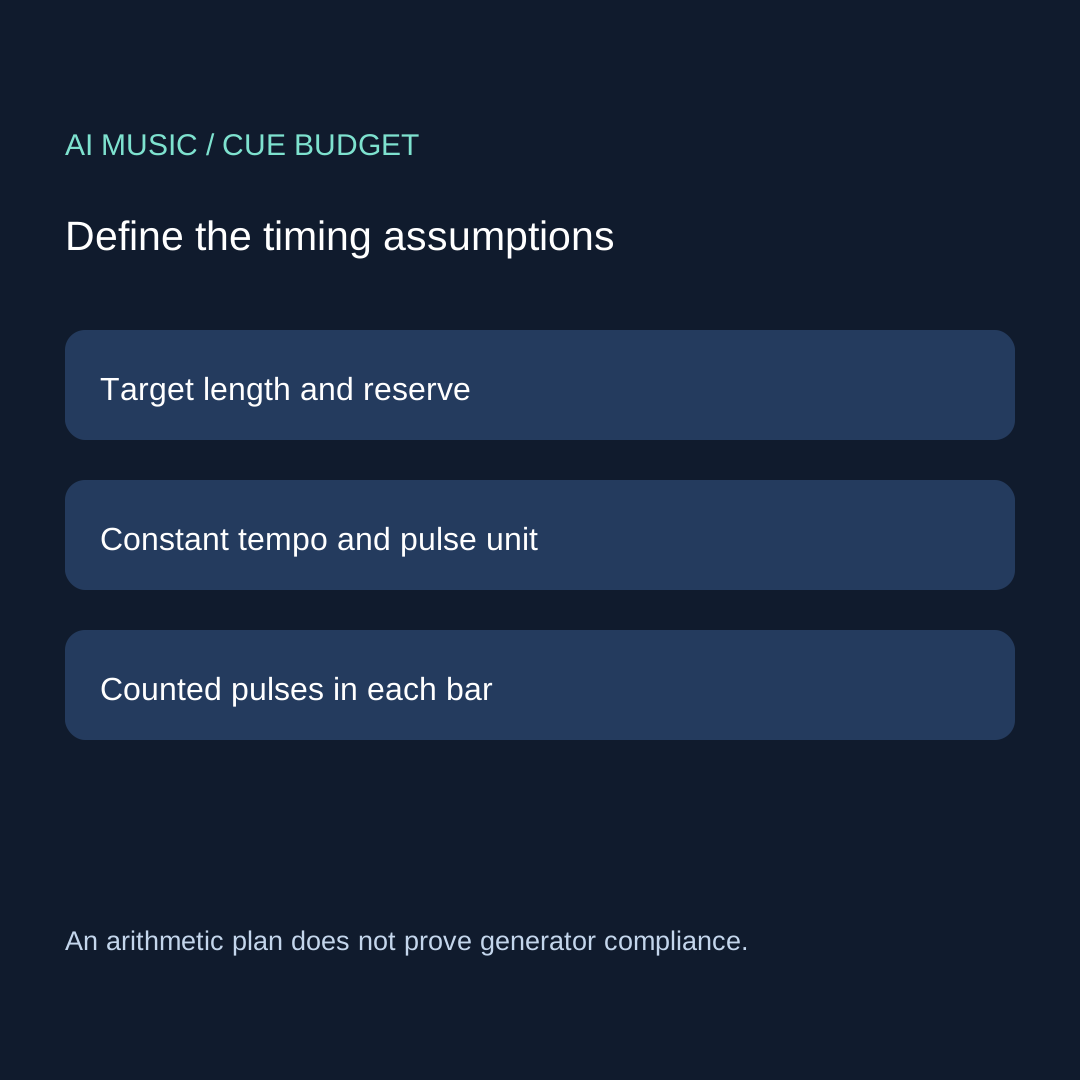
Cue calculator · Assumptions · Five cases · Blank card
Calculate a theoretical cue budget
For an AI music generator free workflow, choose the time budget before spending another attempt. This original planner separates the requested cue length, a reserved lead-in or tail, the counted tempo pulse and the number of those pulses per bar. It is an arithmetic aid, not a promise that any generator follows a duration setting or offers a free export.
A generator-selection question in our material archive supplies the topic lead. We authored five constant-tempo cases, an exact-fraction calculation script, a blank card and this calculator. No music service was tested, and the cases are not measured songs. Treat every result as a plan until you inspect the actual saved take.
Keep the pulse unit consistent
The equations are available seconds = target seconds − reserved seconds; seconds per bar = 60 × counted pulses per bar ÷ BPM; theoretical bars = available seconds ÷ seconds per bar. These definitions assume a constant tempo and the same counted pulse in both BPM and the per-bar value. They do not decide how a tempo label or meter display in a particular tool defines its beat.
Write the pulse you are counting. If you change that interpretation, enter the corresponding per-bar value too. Do not mix a BPM counted one way with a bar count measured another way. A tempo change, pause or freely timed passage requires a different plan or a direct timeline observation; this calculator does not model them.
Five locally executed examples
| Target / reserve | BPM / pulses per bar | Theoretical bars | Whole bars + time remainder |
|---|---|---|---|
| 30 s / 0 s | 120 / 4 | 15 | 15 + 0 s |
| 30 s / 0 s | 100 / 4 | 25/2 = 12.5 | 12 + 6/5 s |
| 30 s / 0 s | 90 / 4 | 45/4 = 11.25 | 11 + 2/3 s |
| 30 s / 0 s | 120 / 7 | 60/7 | 8 + 2 s |
| 30 s / 2 s | 120 / 4 | 14 | 14 + 0 s, with 2 s reserved separately |
We executed the examples with Python's standard-library Fraction so the retained results expose exact ratios instead of hiding rounding. The webpage shows decimal approximations. The readable source recreates the records in its own directory; use a new exercise folder because it replaces a same-named results JSON there. It generates no audio and connects to no account.
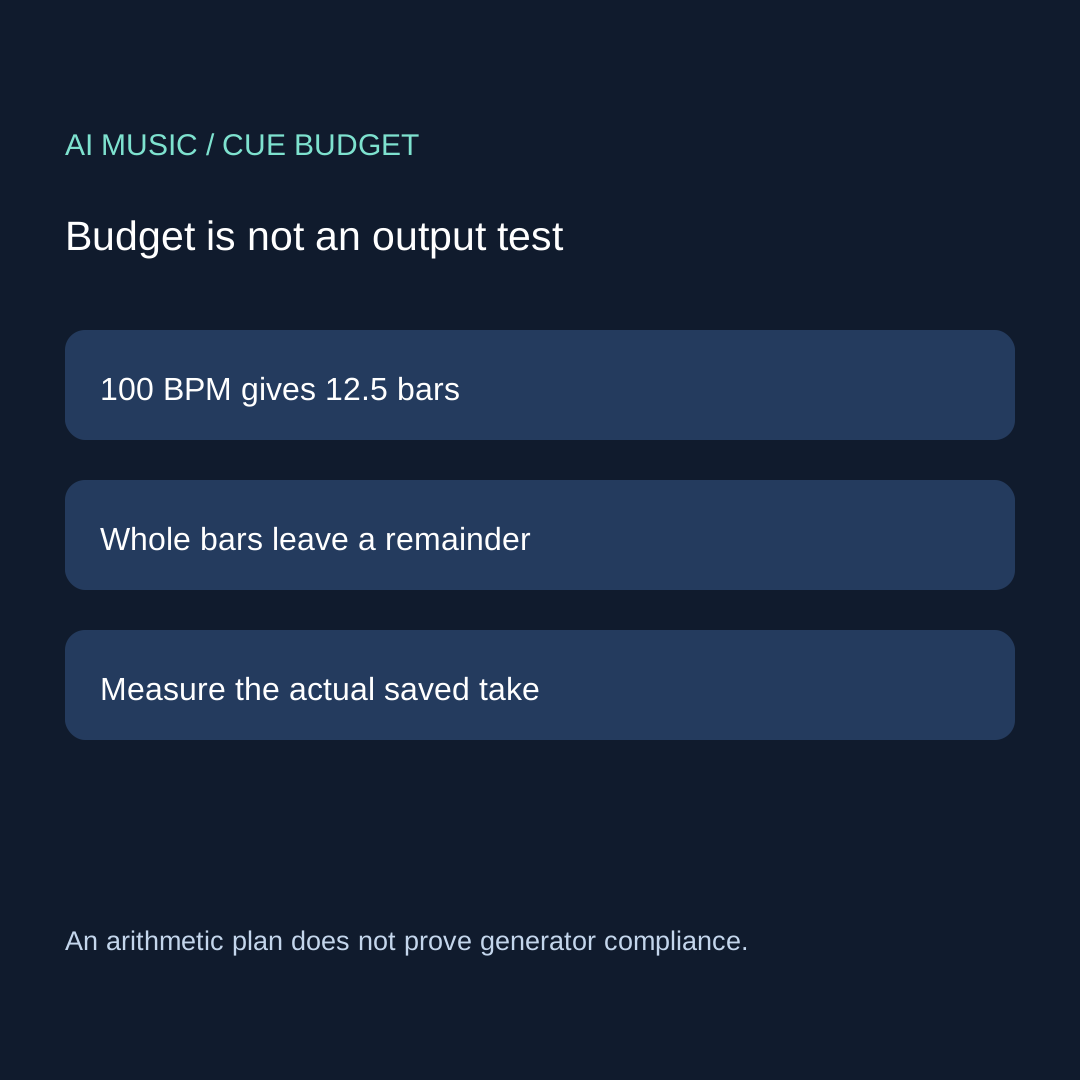
The 100 BPM example illustrates why rounding the requested bars is a separate decision. Twelve full bars use 28.8 seconds, leaving 1.2 seconds in the 30-second budget. Thirteen full bars would use 31.2 seconds. Neither rounding choice automatically creates the requested musical ending, and the remaining time is not an instruction to append silence.
Reserve once, then measure what actually exists
A reserve is a declared allocation, not a detected property of the track. In the final example we allocate two of the thirty seconds outside the calculated bar section, leaving twenty-eight seconds for fourteen two-second bars. Do not subtract the same tail twice, once as reserve and again from the rendered duration. Keep the intended allocation separate from the observed audio.
After generation or editing, retain the exact version and inspect its saved duration, starting event and ending behavior. A file can fit the duration while ending abruptly. A musically complete take can also exceed the slot. Record both observations and choose the next supported edit without calling the theoretical bar count an export verification.
The original cue-budget record
TARGET SECONDS:
RESERVED INTRO / TAIL SECONDS (NO DOUBLE COUNT):
BPM AND ITS COUNTED PULSE:
SAME COUNTED PULSES PER BAR:
AVAILABLE SECONDS = TARGET - RESERVE:
BAR SECONDS = 60 * PULSES PER BAR / BPM:
EXACT BARS / WHOLE BARS / REMAINDER SECONDS:
ACTUAL TAKE / SAVED DURATION / END OBSERVATION:
UNVERIFIED ITEM / NEXT CHECK:
Download the blank cue card. For the start use the export-start record; for the ending use the clean-ending checklist; for repetition use the loop-return card. This planner allocates time before the attempt, while those records inspect the result.
Four questions from the selection workflow
Does fifteen bars guarantee a thirty-second generated song?
No. It is the arithmetic result under the declared 120 BPM/four-pulse assumptions and no reserve. Inspect the actual output separately.
Should I round 12.5 bars up automatically?
No. That changes the budget. Record the whole-bar duration and remainder, then choose an arrangement or editing decision explicitly.
Does a two-second reserve prove there is a two-second tail?
No. The reserve records intent. Listen and inspect the identified take before reporting an actual tail.
Can I use one number when tempo changes?
This planner assumes constant tempo. Split a known timed plan into appropriately defined segments or retain a direct timeline observation; do not claim this single-rate result models the change.